


For a quick and easy color theory project, I had my students choose three neighboring colors on the color wheel to make an analogous watercolor painting. Students began by using masking/painter's tape to break up the picture plane into small, medium, and large, shapes. I like it when the strips of paint go off the edges of the paper, but smaller pieces can work too, as long as there is overlap of tape.
 |
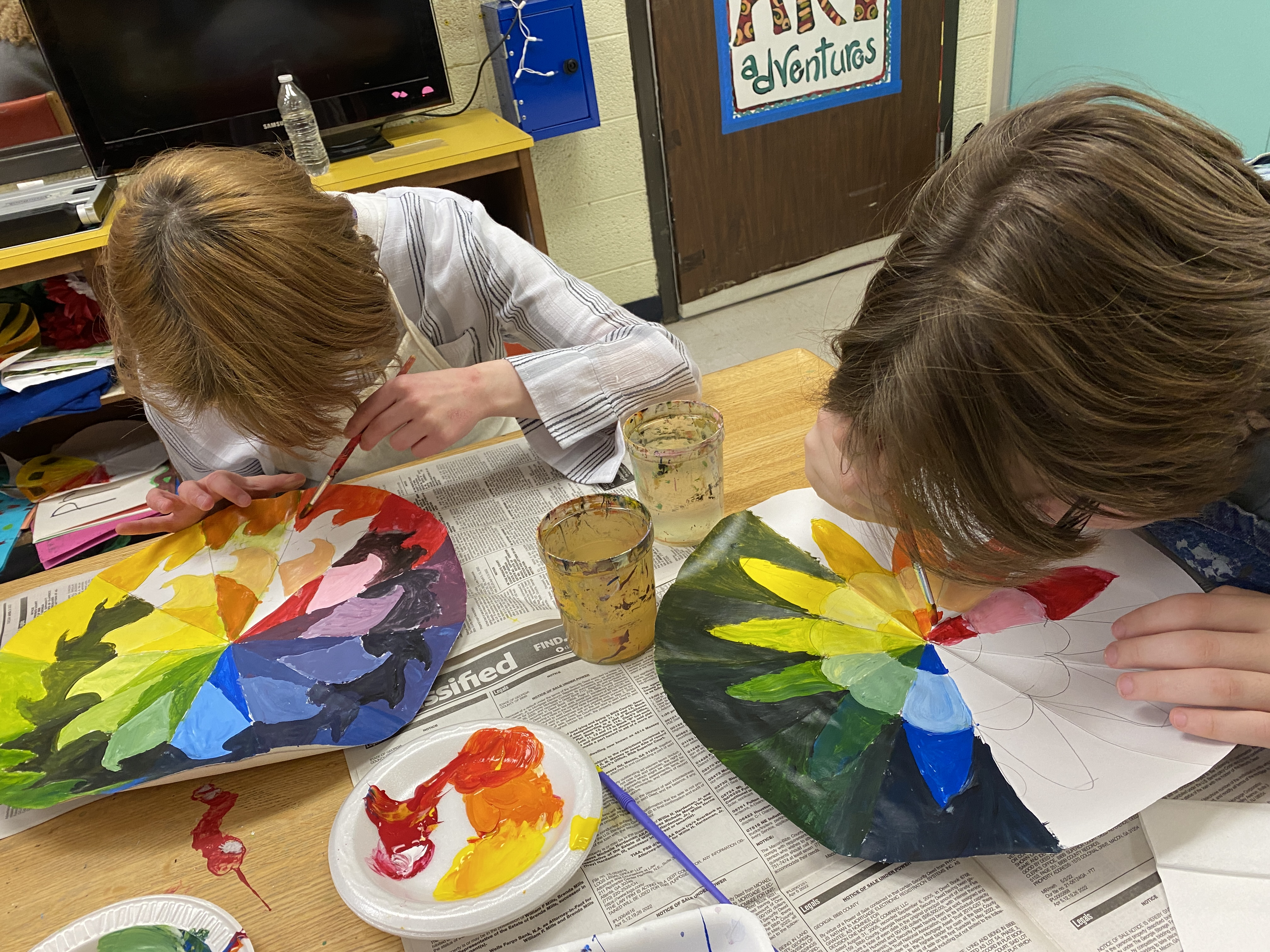
| blind student uses fingers to navigate what parts of the paper still need painted. |
 |
| blind student adding value to tape edges |


Once you have a color wheel made, you can begin to discuss the relationships and positions of colors on the wheel to form color harmonies. A complementary color scheme consists of two colors that are opposite on the color wheel. They have nothing in common, but that's OK-opposites attract! The contrast in these combos pop in a way that make them perfect for sports teams like the Florida Gators or New Orleans Saints.
 |
| yellow-orange/blue-purple compliments |
I teach complements by setting three bottles primary colored paint on a table: red, yellow, and blue. These are the first and most essential colors that you need to make all of the other colors (secondary, tertiary and beyond). Two primaries make a secondary. I ask, "What do yellow and blue make?" "Green!" they answer. "And what is left over?" "Red." ":What is the opposite of green?" "Red!" A primary color's complement is the secondary color that is a combination of the remaining primaries. So in a pair of complementary colors, you get all three primaries. The root of the word complement means "to complete." I continue to hold up a primary colored bottle of paint while students look at the remaining two colors to figure the secondary color that would make up the opposite until the concept is solidified.
Students can also look at their color wheel to find compliments other than the primaries and secondary three combos: red and green, blue and orange, yellow and purple. These tertiary colors are just shifted slightly to be a yellow-orange and blue-purple. or a blue-green and a red-orange. When naming the tertiary colors the primary color always comes first and secondary color second. The name is the recipe for mixing. You would never have an orange-yellow, because orange can't describe a yellow. yellow is yellow. Once you mix in a little orange it is no longer yellow, it is orange.


Some students chose to work markers. Scented markers can be useful for my students who are blind. Others worked in colored pencil. Some were able to shade and highlight their shapes to make the optical illusion a little more effective.


 |
| Braille labels with color initials help students understand upcoming lessons on color harmonies |


