Friday, September 15, 2023

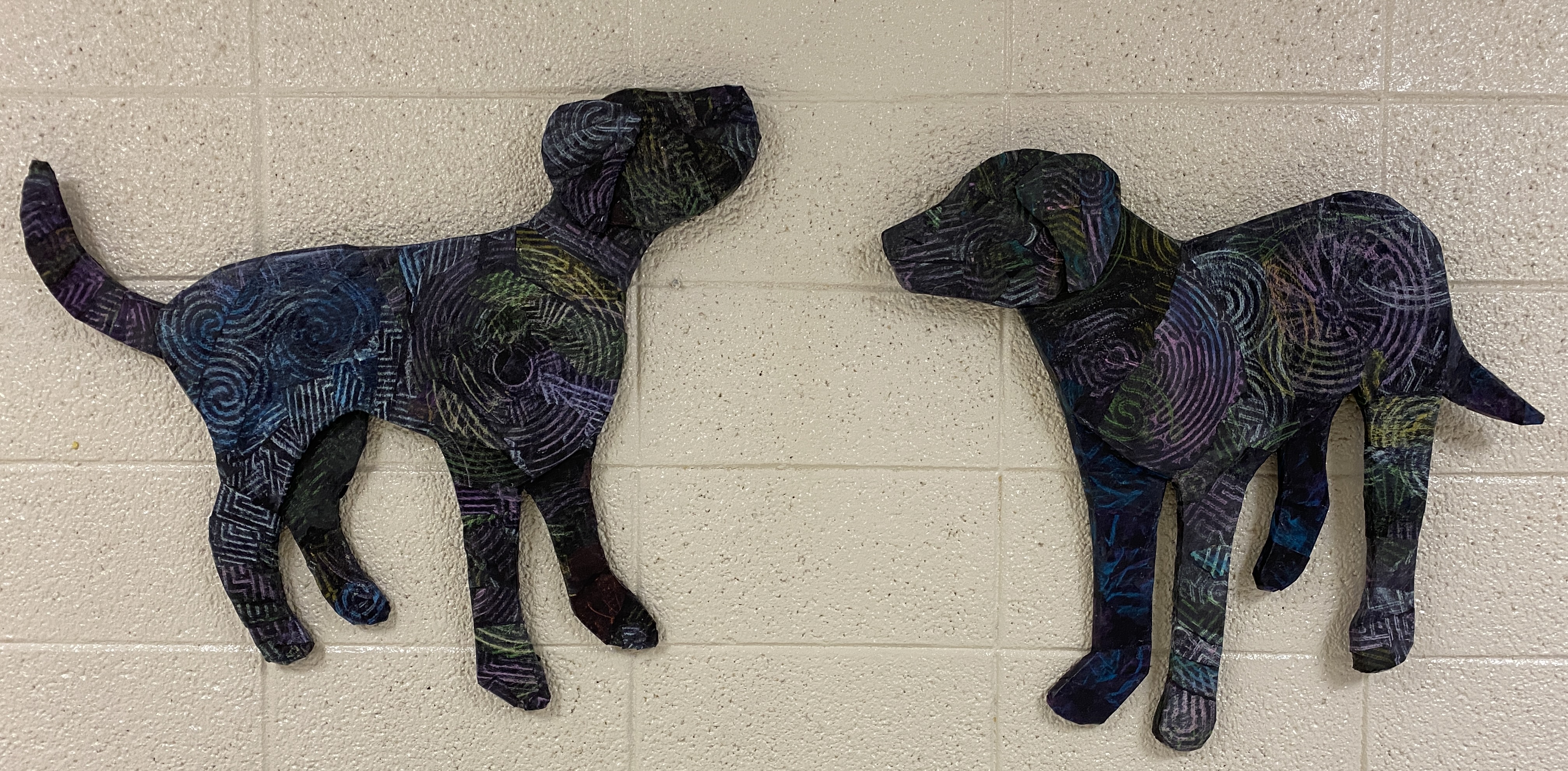
Dog Relief Sculpture, Wall Art


DisneyPlus has show, Critter Fixers: Country Vets, which is filmed in Georgia not far from The Academy for the Blind. In fact, we had some students do some work-based-learning with them on a regular basis last school year, culminating in a school assembly Q&A session with the Critter Fixers stars, Dr. Hodges and Dr. Ferguson. Students were able to walk to different stations on campus, petting various animals and listening to their heartbeat through a stethoscope. It was a great day and we all looked forward to seeing the episode when it came out.

Months later, the show's producer came back and, during a tour of the school, stopped by the Art room and mentioned how nice it would be to have a piece of student artwork on a wall of Critter Fixers. Immediately, the parent mentor, who was giving the tour, mentioned Kirby, as a subject. Kirby is the school's emotional support dog. Minutes after they left, I started looking for pictures of the black Labrador Retriever. Students helped me pick a couple of my sketches, and then they traced the projections onto a large piece of paper to use as patterns.  I used the patterns to cut out layers of cardboard, glued together to make a thick structure. 

Two Middle School students made more rubbings with oil pastels on black paper, based on the past assignment, which they decoupaged onto the structures.  To make the relief structures into something that could be hung on the wall, I had made two holes through two layers of cardboard to thread wire through before adding a top layer of the body.


Friday, August 25, 2023

Oil Pastel-Glue Pattern Project for the Blind

The concept of balance gets more complicated when you try to balance color and shape throughout a composition. The goal is to lead the viewer's eye throughout the piece, placing blues and oranges in ways the form triangles and take value and shape into account as you create some visual stability.

This is especially complicated when you don't have any vision. My students, who are visually impaired or blind began their assignment by setting a squirt of school glue in motion to create a meandering line that crossed over itself to make shapes. The glue created boundaries for oil pastel, but Elmer's isn't a tall enough wall for some of my students, So I would trace over the Elmer's with Wiki-Stix for my students to feel their shapes. Or they would start their drawings with Wiki-Stix and I'd trace them in hot glue before removing the Wiki Stix.
Wiki Stix create boundaries on one or two shapes at a time.
Students would choose where to place each color and then vary the value within the shape, which made it a more interesting than flat shapes. Oil Pastels are easy to use and after coloring for a short amount of time it is easy to feel the difference between plain paper and the greasy patch of color. I was so pleased with how the assignments turned out, proving that you don't need to know how to draw to make a pretty picture, and you don't need to see to make a solid composition.


Tuesday, August 22, 2023

Pattern Rubbings


Stencils are an easy way to create images for people who are blind, but rubbings are another easy form of printmaking that can yield some interesting results. Since we're learning about Principles of design, we used this assignment to talk about pattern and balance, while learning the process and technique of crayon rubbings.
I was was given some really neat tactile mazes, that are used to help beginning Braille students learn now to move their fingers to track lines. While I have students who are fluent Braille readers and some who are just starting, it was a fun activity for everyone to try to navigate their fingers through the mazes.

Then we placed paper on top of the favorite shapes and patterned sheets before rubbling  on the paper and revealing the image. Most of the younger students needed the paper taped to the plastic sheet to prevent it from moving, but we also found that shifting the sheets, or using several different patterned sheets to create a single image made it all the more interesting. Changing colors for each sheet, or even within a single layer added to the complexity. Students peeled the paper from crayons and held them on their side, pushing the crayon perpendicular to the lines that they were tracing.  Oil pastels worked better than crayon on black paper.

I had a few students who just wanted to use one plate to rub, which was essentially copying an image. I told them that it was the combination that made it their own artwork. You take a cookie and you take chocolate chunks and the combination makes a new invention: the chocolate chip cookie. Their job was to make something that hadn't been made before by choosing colors, placement and combinations, not just replicate something that someone else had already made. Some classes also went around the school on texture scavenger hunts, making rubbings of any surface that would make a good rubbing.  Its a fun and quick project that can produce some interesting images.


Monday, August 21, 2023

Symmetrical and Bisymmetrical Art project


I'm starting this school year by teaching the Principles of Design. These are the ideas and beliefs guide us in our art-making, much like grammar is used to organize the parts of speech (nouns, verbs, adjectives, etc.) in written language, the principles of design are the way we organize the elements of of art (lines, shapes, colors, etc.) in art. We're communicating visually. Do we want to communicate a sense of stability and equalibrium? Then we'd better know ways to balance our composition. Do we want to communicate a sense of order and unity? Repeating an element to create a pattern might do the trick.

Why do we see to balance our lives? Our governments? our diets? Our budgets? More importantly, why would we want to balance those things?  Because everything works better and feels better when it's balanced.  

We made symmetrical balance by slowly laying paint-soaked string on one side of a paper and folding it over to print a mirrored image on the opposite side of the fold, or line of symmetry.
Some of these papers were folded both vertically and horizontally to create bilateral symmetry. And some were folded diagonally as well as vertically and horizontally (like a plus sign and multiplication sign in folds) to create radial symmetry.  

My students who are totally blind kept it simple and sprinkled sand onto wet paint to make tactile images. 
These don't take long, so we can cover multiple types of balance in a class period or two. It's nice for students to be able to learn the types of balance by creating them and within an hour have several visual examples of the definitions they're studying.

Friday, July 21, 2023

Summer Art Museum Visits


Cincinnati Museum of Art

U of M in Ann Arbor
Summer vacation means visiting family and stopping at national parks along the way. But I also seek out Art museums and because my husband is an art professor, and my kids are art lovers, everyone is on board.

U of M
University of Michigan has a surprisingly good Art Museum. I think university museums are under-rated and under-used by a lot of the public, especially out of state visitors. But there are gems such as BYU's Museum of Art and Ohio State's Wexner Center that can be added into a traveler's itinerary at no cost. University of Michigan's museum has an impressive contemporary collection with Louis Nevelson and Diebenkorn. There are traditional oil paintings and cabinets with ceramic pieces from around the world. While on campus, check out the Archeology Museum and the Life Science Museum. That's an entire afternoon of looking at ancient artifacts, wooly mammoth skeletons, and priceless works of art for free!


Cincinnati museum of Art
Cincinnati Museum of Art blew us away. My family gave it a unanimous 10 out of 10. There is something for everyone Ancient Egyptian coffins, Greek sculptures, German etchings, English armor. I loved hearing my kids talk about the Hudson River School and Ashcan School paintings, as well as Harlem Renaissance favorites. There's a wall of Picasso's and Monet's Water lilies. One guard explained that while they don't have the biggest collection, everything they have is high quality. We happened to be there on a Wednesday, when they stay open until 8pm and we still didn't have enough time to see it all. (Granted, we didn't get there until 4pm, but still.) The outdoor sculpture garden goes on for miles.

Kentuck Knob in Pennsylvania

As we made our way across the midwest and into Pennsylvania, we stopped at Kentuck Knob, a Frank Lloyd Wright house. We'd planned on seeing the more famous, Falling Waters, but it was sold out weeks in advance. This was slightly less expensive and maybe slightly less impressive, but we were spoiled with how few visitors there were. And the walk from the house back to the visitor's center is almost as fun as the house itself, as there are sculptures along the way, including a section of the Berlin Wall and a couple of Andy Goldsworthy's.

The main reason for our family roadtrip was to visit family in Illinois and Pennsylvania. It was a miracle that all of my parents posterity but one were able to come from 10 states to be together for a week. that's forty-seven of us, snacking at the farmer's market, watching fireworks in my hometown, riding rides at Hershey Park, having family sing-alongs, talent shows, and corn hole tournaments. But that doesn't mean that there wasn't time for Art. My brother and my Art History Professor stopped by the Brandywine Museum to see the Wyeth collection.


And although, I didn't make it there, or to the Philadelphia Museum as I'd originally planned, I did go with my sisters and mom on a self-guided walking tour of Lancaster, PA's murals. They weren't impressive to our family of art snobs, but it was still a lot of fun to be out and looking for the next stop on our scavenger hunt. Whether highbrow or low, on a pedestal or on the street: Art is for EVERYONE. Be sure to make it a part of your next travel experience.


Homemade Soap


Homemade soap was another fun camp craft. We used soap kits, but one of my co-workers use milk from their goats to make soap, and it sells like crazy at the farmer's market.
We passed around essential oils to smell, each student choosing their favorite to use for their soap. Then they chose a mold, a color and any extra stuff, like sparkles to mix in. They melted soap blocks in a microwave for a short time, stirred their scent and color and poured it into a mold. It was a very short project, but when you add in the discussion and essential oil sampling 30 minutes ended up being perfect for 6 students at a time. They ended up looking like little candies, but


Hand-dipped Beeswax Candles


Part of the fun of an agriculture themed camp, is learning how you can use things from the farm to make things for your home--things you might buy at the farmers market. Our class discussions started with the importance of bees in agriculture and the fact that the honeybee is our state insect. We discussed how candles were made during pioneer days, with systems of dipping multiple candles at a time. Since one of our administrators at the school has a beekeeper husband, she was able to get us a lot of free beeswax. The rest, we had to buy. It takes a lot to melt enough wax to fill a coffee can which makes tall narrow cans (spaghetti sauce) or even old, metal thermoses are even better. 
Wax cools quickly, so it took me a couple classes before I was able to  acquire a hotplate for my room to keep it hot enough to work with. If it's too hot, it doesn't really stick.  I kept the can  in a boiling pot, rather than on direct heat. Students worked in groups of 5 or 6, holding a wick with a bolt tied to the bottom. They'd dip it once, count a few seconds and dip it again before getting to the end of the line for the next layer. Once the candle is thick enough, the bolt can be cut off the bottom and the wax around it remelted. Wicks will need to be trimmed when the project is finished,  and then put one on a candlestick and light it. Beeswax smells great and feels authentic. It's a great homestead-y project.