Thursday, September 4, 2014

The Family Writes Part 2: The Benefits of Journaling

In the last post, I talked about the benefits of a family narrative and knowing ancestral stories. Today, I'd like to list a few of the benefits from writing your personal narrative in a journal.
Writing in a journal can help you:
Heal
Journaling is very cathartic. Therapists are wonderful for letting you talk out your problems, but journals can have the similar benefits and save you the $50 copay. Writing allows you to release your stresses, burdens and frustrations through your pen and on to the paper so, you don't need to carry them around in your head.

Think
Writing requires you to organize thoughts and articulate them. I believe that it is through writing that one becomes not only a better writer, but a greater thinker.

Increase Objectivity
There have been times when I have been venting and realized how whiny and one-side my words came across on the page. I've stepped away and from myself and tried to see things more rationally and balanced, and then I am able to come up with the other side of the story.

Increase Happiness
Research has shown that people who keep a gratitude journal are happier. They get better at seeing the good that was already in their lives and good things seem to multiply as a result. Even if it's not a separate journal for documenting blessings, writing about positive experiences will make you feel great!

Increase Awareness
There are times in my day that I will pay special attention to something that is happening so that I can tell my husband about it that evening. I will remember a news story or conversation in greater detail if I know I'm going to share it later, even if it's with a blank book. Writing in a journal, means living life with a greater awareness.

Record History
There are events in my life that I had totally forgotten had taken place until paging through old journals. Details of a time and place that would have otherwise been lost have rushed back to me.  Besides, when there are discrepancies with friends or family members how something happened, the person with the journal entry holds the key to what really happened.

Track Growth   
In reading entries and documented conversations I had in high school, I can see how much I've matured. This gives me more patience with my own teenagers.

Track Miracles
Sometimes it's the seemingly insignificant decisions and events that lead to major life changes. You never know when that guy the secretary just introduced you to, will end up being your spouse, or plane ticket you just bought will affect where you live for the next half of your life.

Cultivate Humor
Journals are more fun when they are funny. Seeking out the humor in the day or even finding it after it happened when you sit down to journal is a great pleasure. And humor can be cultivated and make life in general more bearable.

Learn to Type
When I was in 9th grade and taking a keyboarding class, I'd come home and type a single spaced page a day about my day. My typing skills grew more rapidly than my peers as a result.

Journal writing is a hobby, a skill builder, a way to let off steam and see beauty. Why not dust off the old diary and get reacquainted with yourself?


Saturday, August 2, 2014

The Family Writes

“The single most important thing you can do for your family may be the simplest of all,” according to Bruce Feiler, “develop a strong family narrative.” In his New York Times article, The Stories that Bind Us (March 15, 2013), he told of a study done by psychologist, Marshall Duke and Robyn Fivush, of Emory University, in which they asked children of four dozen families questions about their parents or grandparents. It is called the Do You Know Scale.


“Dr. Duke and Dr. Fivush then compared the children’s results to a battery of psychological tests the children had taken, and reached an overwhelming conclusion. The more children knew about their family’s history, the stronger their sense of control over their lives, the higher their self-esteem and the more successfully they believed their families functioned. The Do You Know Scale turned out to be the best single predictor of children’s emotional health and happiness” (Feiler, 2013).


I tried some of these questions on my own children. “Do you know about the day you were born?”


“The midwife had a fuzzy sweater!” my daughter exclaimed.


“Do you know how Dad and I met?”


"You were at Ohio State!" my son said.


“In the Art Department! Something about that guy Jeff,” my daughter hoped for extra points.


I don’t know whether or not the stories they’ve heard so many times are making them more successful and emotionally resilient but when I consider how I deal with frustration and setbacks, family narrative matters enormously. I often look to my ancestors, one of who was pelted with stones, ship wrecked, and driven from his home at gunpoint when he was near death with illness. Then I realize that maybe waiting eight months for a rejection letter from a publisher isn't such a big deal.


World War II ended on the day my uncle was supposed to be executed in a German prisoner of war camp. So maybe things will work out for me in the end too.

When elderly people have looked on disapprovingly at my unruly toddlers and lectured me about how children were well mannered “back in the day,” I could nod soberly while internally giggling at the fact that one of my ancestors, as a child, almost blew up the Mayflower.


It is a gift to be a part of a bigger story. It is a gift to know that people went before, and did hard things—and we can too. But family narrative is more than just stories of trials that keep us from whining, or stories of inspiration that keep us following our dreams. It is also the way we define ourselves.


When my middle child was twelve, I said, “I’m not sure if you know this or not, but education is pretty important to your dad and me.”

“Na-ah. Really?” he said sarcastically.


Of course he already knew. He knew without me needing to say it because he knows that at family reunions, when my parents sit down with their six children and our spouses around a campfire, there are thirty plus college degrees sitting around the campfire. He knows because he sees us studying, teaching, checking homework, and living on the academic calendar. I don’t need to say it explicitly, but I do it anyway, and when I do, I am articulating the narrative.


The other day I asked my family the five major things that define us and every person included fine arts, travel, education, and faith in their list. My kids haven’t ever met my Grammy Award winning/ Broadway performing cousins, but they know that music, dance, and art are important to our family and when they say it out loud they are articulating a narrative.


It is easier for a kid to stand up to peer pressure when she sees herself playing a role in the family narrative. “No thanks, we don’t smoke,” implies that she is not alone.

And in fact, kids are never alone when they have a family and a family story to tell, reflect upon, and be a part of.

Friday, July 25, 2014

Home Sweet Studio


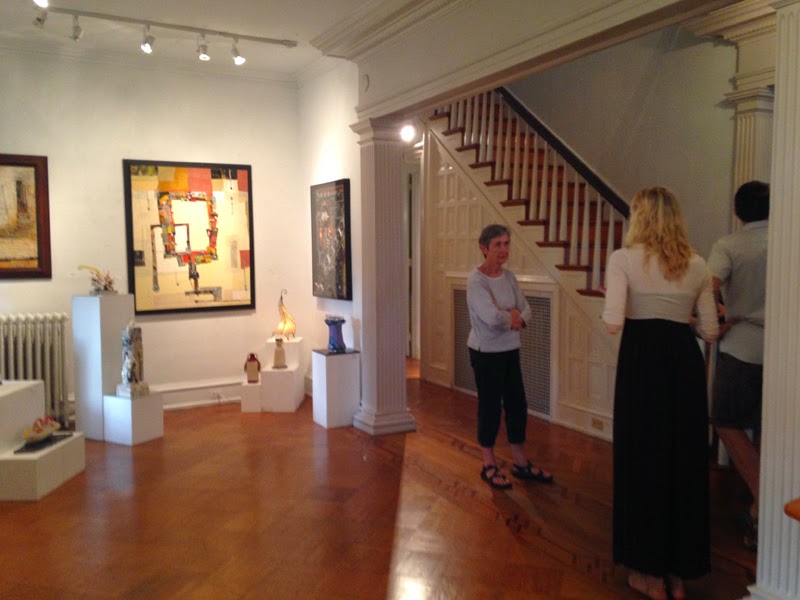
 This summer I took an overdue trip to my hometown of Marietta, Pennsylvania. There I visited the Marietta Art House, which has recently closed and will soon be for sale. It is not only a gorgeous art space, but also the home of my dear high school friend, Mary Beth Lavin. We spent many cans of hair spray and hours of boy-talk here a couple decades ago.

 Mary Beth gave a tour of the home and gallery where her mother, Claire, displays her work.


When I was four years old, my brother and I took a craft class from Claire Lavin. It was my first formal experience in art making. Happiness is being able to be able to sit in the same studio where my art career began.


After the trip, I painted the studio in our home.  Here is the before shot...

    And here is the after. A little color makes a big difference.

Thursday, May 29, 2014

Sculpture, Watercolor, and Mandala

I tried to cram as much in before the school year ended as possible and thought I'd share a few assignments that my visually impaired students enjoyed the most.

Wooden Sculptures. My friends, Heather and Drue McCroan make elaborate wooden monograms for people to hang on their door or put over their mantel. They offered me the wood scraps and I, in turn, offered them to my students. They played, balanced, re-arranged, sanded, glued and painted these wooden pieces with some interesting results.


Our beautiful campus and our spring weather made for a perfect landscape opportunity. We started with an exercise to explore what watercolors can do. Students tried wet-on-dry, wet-on-wet, blotting, wax resist, and blending techniques before they could begin their landscape project.


The better the vision, the more accurate the images, but I also love the energy that comes from the marks of those who can see almost nothing.


Nothing says wholeness and perfection more than the circle. As a class we explored Native American medicine wheels, rosary windows found in many cathedrals, and we watched videos of  Bhuddist monks making amazing sand art creations before sweeping them away as a symbol of impermanence. Each student made their own mandala with the help of a light box, and a basic knowledge of fractions and balance.

Art projects for Learning about Our World

Art and Social Studies pair perfectly in the classroom. In March, when our town was exploding with Japanese Cherry Blossoms, I taught a unit on Japanese Art.  Japan is dear to my heart, having lived in Hokkaido for more than a year. I began by teaching students about the culture: traditional food, dress, homes, gardens, religion, and even some basic phrases. We handled artifacts and tried on a  kimono.
I read “One Leaf Rides the Wind” which is a counting book of haikus that teach about bonsai trees, pagodas, koi fish and tea ceremony. I have students figure out the pattern of the haiku from my reading, and then they write a haiku about themselves. They mount this under their name, written with sumi brush and ink in katakana (Japanese characters). Younger children decorated large koi fish wind socks I made from bulletin board paper.

We also used brush and ink to do some bamboo studies. I managed to bring in fresh bamboo with leaves for students to feel and better understand the brush strokes.

Japanese are famous for their wood cuts, and so we study Hiroshige prints and talk about the printmaking process, before making our own relief prints. I’m not comfortable giving visually impaired students carving tools, so we just used pencils and foam to create our images and then brayer and ink to edition them.


Greek Art is fun to teach, because the students love me to read myths to them while they work. We listened to a documentary on ancient art, used white sheets for over-clothes togas, and discussed the culture at length. We looked at how and why our government buildings resemble those of Ancient Greece, and I asked them to find each type of column capitol (Ionic, Doric, Corinthian) in our community, which is flooded with neoclassical architecture.  Students used charts of vase forms to create their own symmetrical, black-figure vase image, complete with a stylistic narrative from their life.


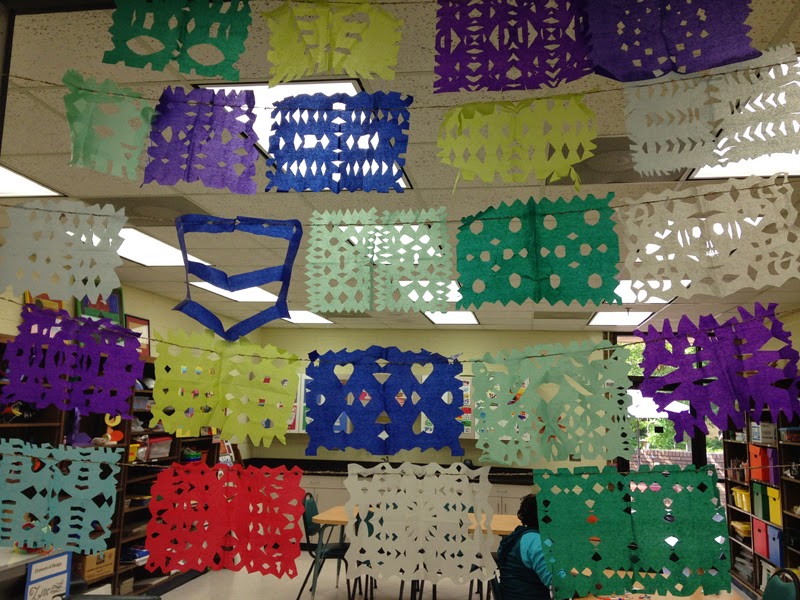
I didn’t realize that Cinco de Maya was a bigger deal in the U.S. then much of Mexico, until this year. I played the NPR story "Cinco de Mayo: Whose Holiday Is It Anyway?" for my students, and we looked at images from Mexican culture. Older students cut tissue paper which teaches use of negative shape, balance, and pattern. (Saved scraps are great for collages and contact paper stained glass projects.)


Elementary school students filled plastic Easter Eggs from home with dry rice or beans, to create papier machie maracas, which they painted and played to mariachi music. This seemed to be a favorite project for some of my non-verbal students.

Wednesday, May 28, 2014

Mud, Cloth, and Kids

I started out my second semester at the Academy for the Blind teaching a ceramics unit.  The youngest of students could figure out how to roll a coil to make trivets, or make slab tiles on which to make texture by pressing sea shells. Middle and High School students started with small pinch pots turned into animals.
 Some students left their pot upright, for  vessel-like head or body, while others turned theirs sideways (for a mouth), or upside down (for a shell).
 We used the slab roller to make boxes and some of those boxes looked less boxy than others.


I worked with each high school student individually, guiding their hands to show them how to throw pots on the wheel. I never found a pedal or base for the wheel, so we set the wheel on a table and used it standing, without control over speed. It was a challenge for me to get used to, but students who never used a potter’s wheel before didn’t know the difference and most were pleased with the results.


I also taught a unit on quilting. There are so many great picture books like, “The Keeping Quilt” and “The Patchwork Path” which open up meaningful discussions about the stories quilts tell. We studied Amish quilts as well the fabulous Gee’s Bend Quilters. Repetition and crystallographic balance were the design principles we emphasized through individual pattern studies.


 That led to individuals contributing favorite patterns to make Class paper quilts. Quilting is traditionally a collaborative process.The youngest students picked from piles of smaller squares which had been divided by hot glue lines to help them use the space.

The older students used fabric markers to make a school-themed quilt block that they could then sew, iron, and quilt. Nothing warms my heart more than to see macho teens using a sewing machine. That week, we went to the amazing quilt exhibition at the local Museum of Art and Science, where students were able to play with traditional and non-traditional textile materials.

Saturday, January 25, 2014

From the Art Classroom

I love that my blind and visually impaired art students say, "It's nice to see you."
When something is amiss they might say, "That doesn't look right," and when they understand what I'm talking about, they say, "I see."
The fact that their eyes don't work perfectly, doesn't mean they have to use a different phrases then sighted people. They live in the same world, and deserve to understand what people are talking about when they make references to art. They also deserve to try their hand at art projects. Art, after all, is for everyone.


I recently had my students empty their portfolios onto the wall for a critique. It is so fun to track 
their progress and how see much they've accomplished in the last few months.


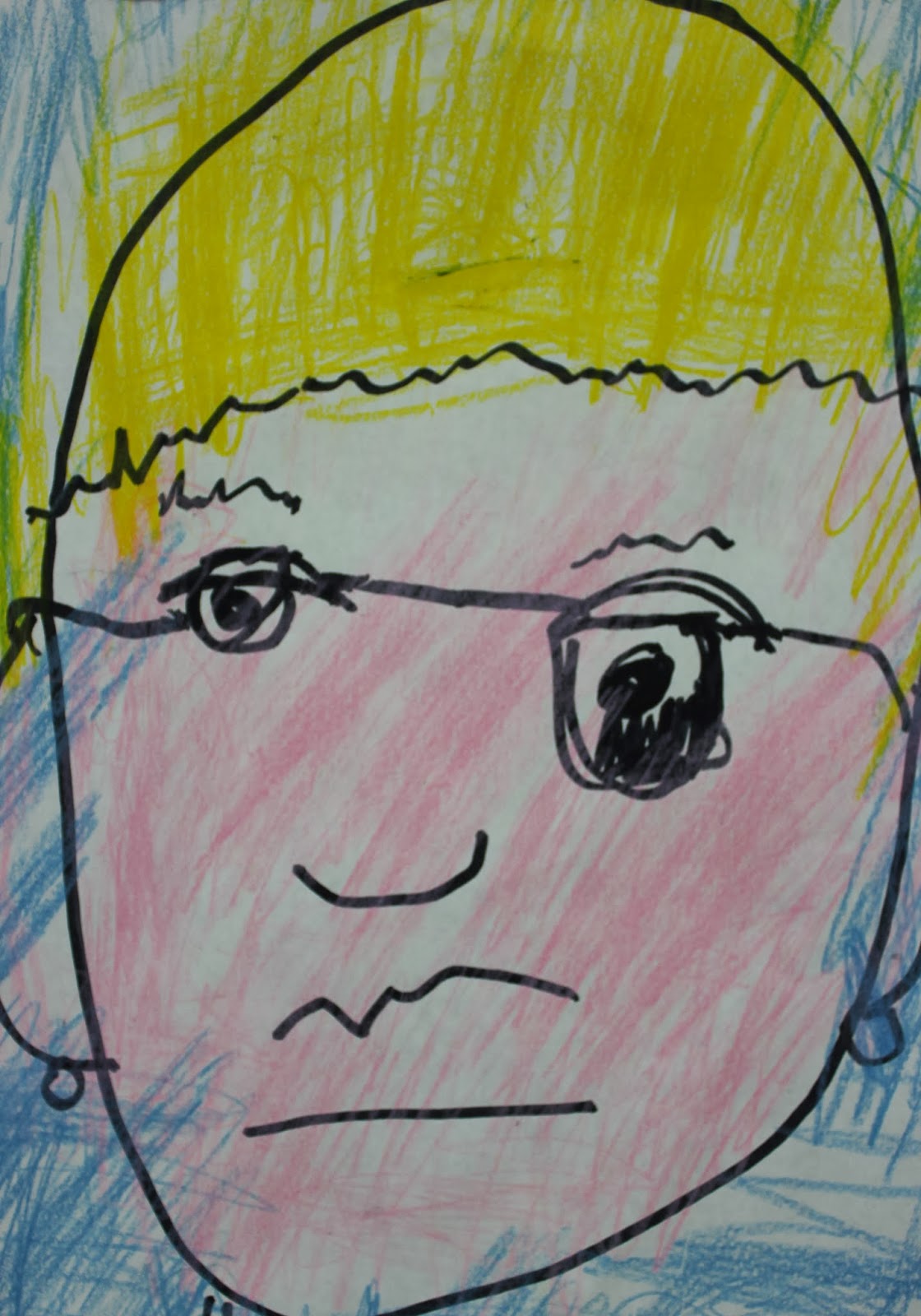
I had each student pose in front of their work while I took their pictures. I can't share the photos of them, but I can share a few of their self portraits.


 We talk about line of symmetry and proportions. Mirror's aren't always useful, but students can use their fingers to determine how far apart their eyes are, and what fraction of their head is taken up by their forehead.
This student used wiki sticks to "see" his "drawing" as he worked.


Tessellation projects are are a favorite way to teach math/art concepts of perimeter, shape and pattern. I have a slide lecture of M.C. Escher images that I describe in detail to those who can't see, and then they used wiki sticks to trace the templates they made.


Observational concepts such as linear perspective and use of value to show three dimensions were tackled by my low vision students.   


Right before winter break, we studied Andy Warhol before doing screen prints of snow flakes. And we learned a little about Frank Lloyd Wright and architecture before building and decorating graham cracker houses.