Showing posts with label linear perspective. Show all posts

Wednesday, August 16, 2017

Teaching Linear Perspective to The Blind

In the book, PAINTING IN THE DARK,  ESREF ARMAGAN, BLIND ARTIST, Rachelle Burk describes how a blind boy, growing up in Turkey during the 1950's and '60's, wanted to learn about perspective,  which is, "creating a three dimensional appearance on a flat surface. This was a difficult concept so he sought the advice of an art professor who explained how size and angles show depth in a picture. The professor drew examples for Esref to feel, demonstrating how a road or bridge appears to narrow to a point as it stretches into the distance. Esref understood applied the methods to his work. He practiced until he could paint in perspective as well as many sighted artist."


All of my art students are legally blind, which means they have 20/200 or worse vision, in their best eye, with glasses. I teach those with a little bit of vision, two-point perspective drawing much as I would a sighted child. We start with a horizon line with two vanishing points at either end (often going off the page onto paper taped underneath) and then determine where the tallest vertical line, the closest corner of a building, will intersect the horizon line.  Lines are drawn from top of the vertical line down to each vanishing point and from the bottom of the verticle line up to the points.  The width of the front of the building is determined by cutting the triangle made from the building corner to one point, with another vertical line. Another vertical line is used to make the side of the building.


For students with no vision at all, the process was a little more abstract. They followed the instructions using using wiki sticks. I traced their wiki stick lines with hot glue, and then removed the wiki sticks, to make it more permanent and able to withstand coloring.


Some low vision students used a Visio Book, a closed circuit TV, as a magnifier to add details.


Just because perspective drawing is a concept based on visual illusion, doesn't mean that the visually impaired can't rise to the challenge of learning something about how their sighted friends experience the world. In fact, in Burk's book, she explained that when Esref Armagan had an MRI done while painting,  the part of his brain that controls sight, lit up. He was able to see with his finger tips, and others can learn to do the same.

Tuesday, July 14, 2015

The Point of Linear Perspective

Learning how to draw using the rules of linear perspective can be empowering for a student. Unfortunately, it can also be daunting and frustrating; so I start with a very basic one-point perspective exercise. My students and I talk about what a horizon is (where the sky and earth meet), and how that horizon changes depending on whether you are lying in the grass or flying in a plane. The horizon line is always eye level. That means that even when you are in a building, and can't see the sky and earth, you still use your eye level for the horizon line.  I even move a chair to the wall and sit down to count how many cinderblocks from the floor my eye level is to determine how high up the wall (or piece of paper) it would be.

Students draw a horizontal line for their horizon line, before drawing shapes (geometric or organic) above and below the line. We discuss the difference between shape (2D) and form (3D) and when I name a shape, they tell me the form version.  A circle can become a sphere or a cylinder. A triangle can become a pyramid or a triangular prism. In order to add dimension to their flat shapes they need to pick a point on the horizon line.  This is called the vanishing point. If you watch a cowboy ride off into the sunset, he will appear smaller and smaller until he finally disappears (thanks to the curvature of the earth). This is the vanishing point. Poet laureate, Billy Collins was referring to the vanishing point when he wrote, "You have heard of the apple that astonished Paris? This is the nostril of the ant that inhaled the universe."


Rulers were used to connect the vanishing point to the corners of shapes. If there are curves, the line becomes like a tangent, going to the outer edge of the shape. Finally, value and color can be added. Most of my students who did the exercise are visually impaired, but the example here is a student who is completely blind. He may never experience watching a cowboy ride off into the sunset, but he can understand the concept better now that he's made a tactile graphic using the principles of linear perspective.  And this concept helps those of us with sight understand why things look the way they do.


Saturday, January 25, 2014

From the Art Classroom

I love that my blind and visually impaired art students say, "It's nice to see you."
When something is amiss they might say, "That doesn't look right," and when they understand what I'm talking about, they say, "I see."
The fact that their eyes don't work perfectly, doesn't mean they have to use a different phrases then sighted people. They live in the same world, and deserve to understand what people are talking about when they make references to art. They also deserve to try their hand at art projects. Art, after all, is for everyone.


I recently had my students empty their portfolios onto the wall for a critique. It is so fun to track 
their progress and how see much they've accomplished in the last few months.


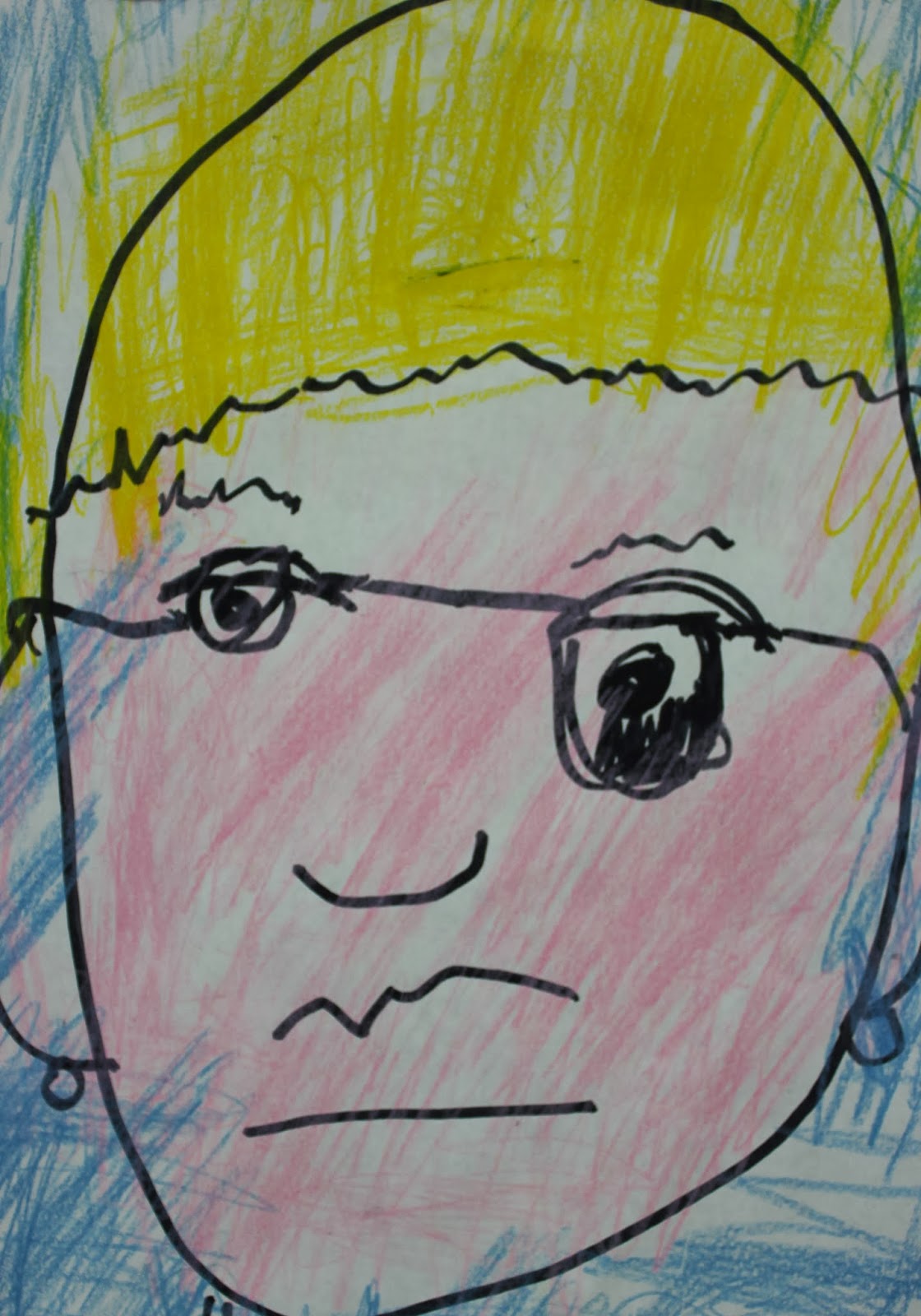
I had each student pose in front of their work while I took their pictures. I can't share the photos of them, but I can share a few of their self portraits.


 We talk about line of symmetry and proportions. Mirror's aren't always useful, but students can use their fingers to determine how far apart their eyes are, and what fraction of their head is taken up by their forehead.
This student used wiki sticks to "see" his "drawing" as he worked.


Tessellation projects are are a favorite way to teach math/art concepts of perimeter, shape and pattern. I have a slide lecture of M.C. Escher images that I describe in detail to those who can't see, and then they used wiki sticks to trace the templates they made.


Observational concepts such as linear perspective and use of value to show three dimensions were tackled by my low vision students.   


Right before winter break, we studied Andy Warhol before doing screen prints of snow flakes. And we learned a little about Frank Lloyd Wright and architecture before building and decorating graham cracker houses.