After a week of studying about ancient Greece, my class moved on to learn of Ancient Rome. Mosaics weren't invented in Greece or Rome but that's where they were perfected, and Rome is full of beautiful micro-mosaics that look almost like paintings. Rome was home of something else too: a saint named Valentine. As legend has it, he secretly performed weddings for Roman soldiers who were forbidden to marry, and for this he was put to death. Another story of perhaps another St. Valentine (It seems there were a couple martyrs with the same name) says that he visited downtrodden and mistreated Roman prisoners gifting cards... or that he was a prisoner who fell in love with a girl who visited him, maybe the jailor's daughter and that he signed a letter "From your Valentine." The Christian based holiday of St. Valentine's was a replacement for the Pagan mating rituals of February, Lupercalia. Roman's went people being killed for being Christian to being killed for not being Christian. Valentine's Day today has references to both Christianity and Pagan history: St. Valentine, who was a Catholic, the Greek god Eros, whose Roman name is Cupid, and his mother, the Greek goddess of Love, Aphrodite, whose Roman name is Venus, although I'm guessing most people aren't thinking about religion at all when they sign their Valentine's Day card.
To make our Valentine mosaics, my students used hearts that were cut from painted or colored mat board, a smaller heart was cut from within, and smaller pieces of half a small heart at a time were cut and glued. It's too hard to keep track of very many cut pieces at a time, so we focused on 4-8 at a time. The other small half and then the outer heart, half at a time were glued into place leaving little cracks. We talked about the idiom "broken heart" and played a game to try to see how many song titles we could name with the word "heart" in it. Normally, I'm not a fan using art class to make holiday crafts, but it fit so well with the curriculum of ancient cultures and art history that I couldn't resist. A glued piece of ribbon on the back makes it easy to hang on a wall or on the door nob of a loved one as a gift. Love big everyone!
Showing posts with label Ancient Greece. Show all posts
Monday, February 8, 2021
Thursday, January 28, 2021
Ancient Greece Art Lesson
Because all of my students were distance learning during this peak COVID time, I wasn't able to do the ceramic ancient pottery assignment I'd hoped to give. But students were still able to create their own pottery design. Here is one using Geometric Period style figures (some of the borders are from the Classical or Hellenistic period for fun). It tells the story of distance learning on laptops and being sick in bed with the famous virus. This teaches students stylization, story telling, decorative borders, and shapes/uses of ancient vases. It was also the perfect time to learn the parts of a vase: the foot, body, shoulders, neck, mouth, lip, and arms. Students began by choosing their favorite ancient vase shape, folding a piece of paper in half, drawing half the vase along the folded edge, and cutting it out.
Drawn, traditional borders decorate the top and bottom as well as break up the space. And then the body is used to illustrate a scene from daily life, political event, or ancient mythology.
Turns out the internet has dozens of great (and short) videos about Ancient Greece, which came in handy with our K-W-L chart. Day one, each student said what they knew and what they wanted to learn. They each had to come up with a list of facts to add to the L (What they learned) section of their chart. It's a great interdisciplinary experience that helps students relate how art fits into the story of humankind. Advanced students learned the golden ratio and how math was used to make the Parthenon so beautiful. Ultimately, art makes more sense when taught in context of ones life and one's world.
Thursday, May 29, 2014
Art projects for Learning about Our World
Art and Social Studies pair perfectly in the classroom. In
March, when our town was exploding with Japanese Cherry Blossoms, I taught a unit on Japanese Art. Japan
is dear to my heart, having lived in Hokkaido for more than a year. I began by
teaching students about the culture: traditional food, dress, homes, gardens, religion, and
even some basic phrases. We handled artifacts and tried on a kimono.
I read “One Leaf Rides the Wind” which is a counting book of
haikus that teach about bonsai trees, pagodas, koi fish and tea ceremony. I
have students figure out the pattern of the haiku from my reading, and then
they write a haiku about themselves. They mount this under their name, written
with sumi brush and ink in katakana (Japanese characters). Younger children
decorated large koi fish wind socks I made from bulletin board paper.
We also used brush and ink to do some bamboo studies. I
managed to bring in fresh bamboo with leaves for students to feel and better
understand the brush strokes.
Japanese are famous for their wood cuts, and so we study
Hiroshige prints and talk about the printmaking process, before making our own
relief prints. I’m not comfortable giving visually impaired students carving
tools, so we just used pencils and foam to create our images and then brayer
and ink to edition them.
Greek Art is fun to teach, because the students love me to
read myths to them while they work. We listened to a documentary on ancient
art, used white sheets for over-clothes togas, and discussed the culture at length.
We looked at how and why our government buildings resemble those of Ancient
Greece, and I asked them to find each type of column capitol (Ionic,
Doric, Corinthian) in our community, which is flooded with neoclassical
architecture. Students used charts of
vase forms to create their own symmetrical, black-figure vase image, complete
with a stylistic narrative from their life.
I didn’t realize that Cinco de Maya was a bigger deal in the
U.S. then much of Mexico, until this year. I played the NPR story "Cinco de
Mayo: Whose Holiday Is It Anyway?" for my students, and we looked at images from
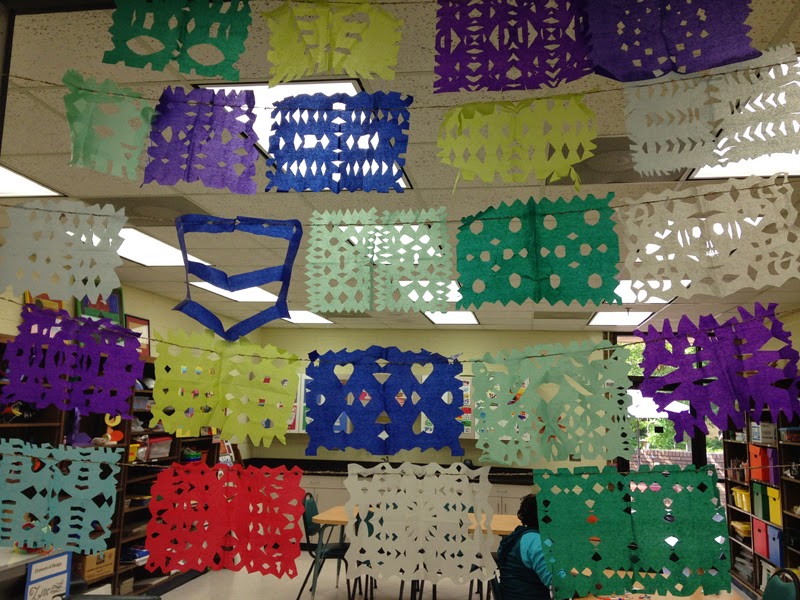
Mexican culture. Older students cut tissue paper which teaches use of negative
shape, balance, and pattern. (Saved scraps are great for collages and contact paper stained glass projects.)
Elementary school students filled plastic Easter Eggs from home with dry rice or beans, to create papier machie maracas, which they painted and played to mariachi music. This seemed to be a favorite project for some of my non-verbal students.
Subscribe to:
Posts (Atom)