Wednesday, October 19, 2022

Alumni Achievement Award

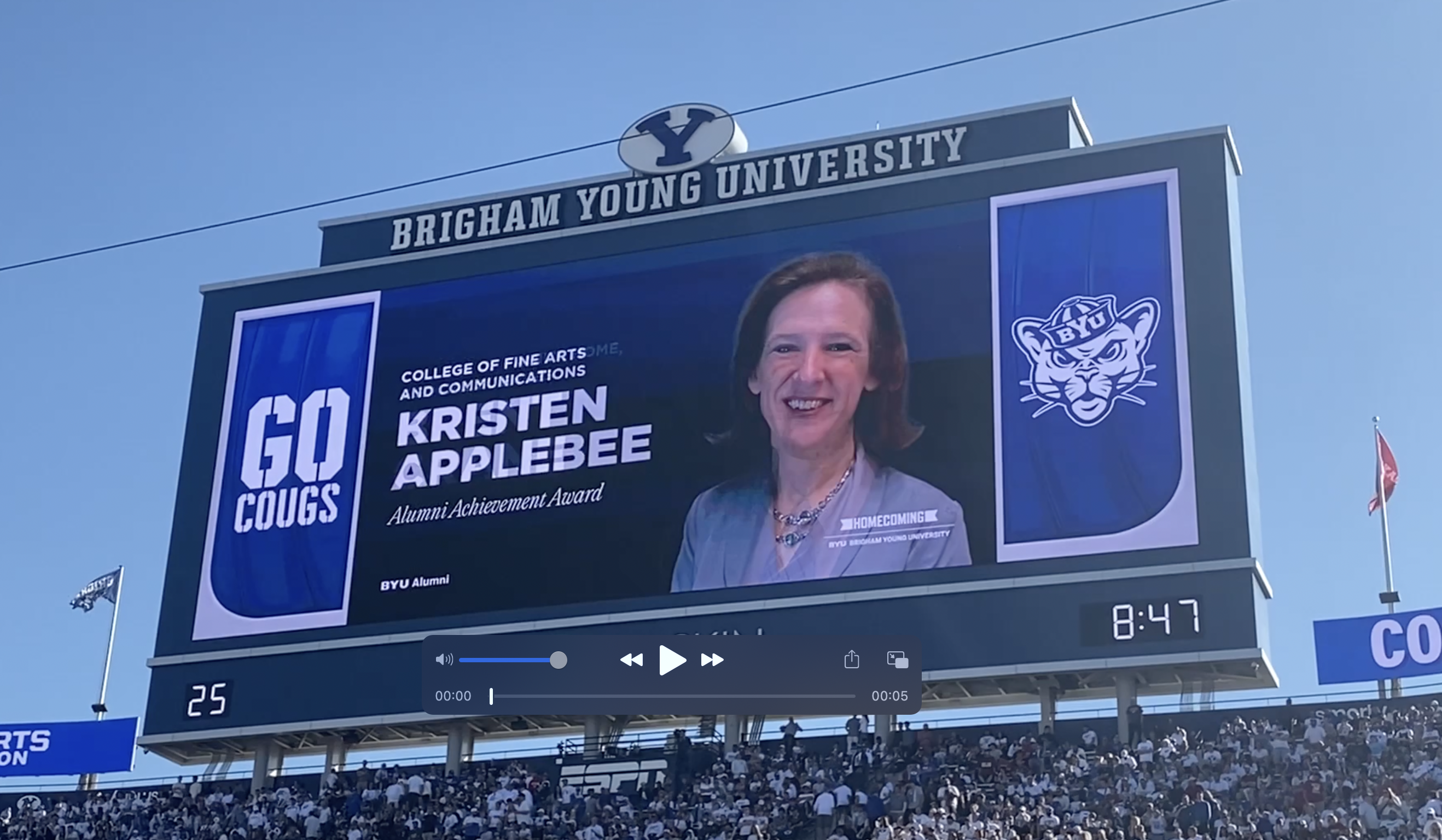
 When Brigham Young University told me I was going to receive the College of Fine Arts and Communication's Alumni Achievement Award, I wondered how they found out about the twenty pounds I lost during COVID quarantine. If that wasn't my greatest achievement, I don't know what was. I didn't ask questions, I just showed up and let them pamper me.

photo by Scott Young

Photo by Scott Young
One of my favorite parts about my trip to Utah, was getting to give a lecture in the Harris Fine Arts building, where I "lived" as a student for six years. It's hard to believe they will be tearing down the building in just a couple of months, to build a new one.
I spoke about my belief that accepting the life calling of an artist is an act of faith. There will be times when you will be asked to do what seems impossible, but if you step up and try, you'll be able to look back with joy at what you were able to accomplish. There were so many familiar faces in attendance, including childhood friends from Pennsylvania, and  students whose parents I knew from living in Georgia and Ohio. 


My old art buddies and professors from 26 years ago were in attendance at the awards luncheon, as well as some family members. The greatest reward was reconnecting with loved ones! (But I'm not going to say "no" to the goodie bag with football shaped fudge).

They gave me tickets to an amazing ballroom dance performance and my daughter and I to run a 5K. It's the second time in my life I'd ever done that, and the first time in 35 years. I beat my high school time by 4 minutes and lost 8 pounds, the last couple of months while training for it. Getting the award changed my life before I even showed up on campus. My husband and I loved our stay at the campus guest house.


A bonus was getting to take my daughter to the homecoming game and watching from the President's Loge. They had some amazing food and a great view of the field. After the marching band did their half time show, I was able to walk onto the field with the other award winners and wave at the crowd.  My picture was also on the Jumbotron. The week was truly an opportunity of a life-time and one I will never forget.


APH Insights Art Contest Field Trip


After two COVID years and an online ceremony, it was so great to finally get to take my students to Kentucky for an in-person APH Insights Art Contest exhibit and awards banquet.

I had five student pieces that got into the show, and was able to take four students, including two of the three award winners. 
It's a thrill for me to take students who have never flown before on a plane. We definitely got our share of ECC (Expanded Core Curriculum) practice. Students with visual impairments are required to learn skills to navigate life, on top of the normal school curriculum. Orientation and Mobility, for example is an important skill that we used a lot: using elevators, escalators, moving sidewalks, buses, Uber cars, planes, airport trains-we did it all! And don't forget the experience eating a fancy meal and knowing which of the 3 forks, two knives, to use first.

While we were in Louisville we took advantage of the Jacko-o-Lantern Spectacular! All four of my kids were low vision, rather than totally blind, so they could appreciate the lights, and they loved the sounds and music throughout.
The tour the Kentucky Museum of Art and Craft is always a treat, as we get a guided tour with great audio description. I hope Kevin never retires.


And of course, the tour of the American Printing House for the Blind is interesting. We see giant rolls of Braille paper that stretch 3.2 miles long, watch someone recording an audio book, and get to peruse the museum that includes Stevie Wonder's piano and Helen Keller's desk.

It was a fantastic trip and will inspire other students to work hard and try to submit top-notch art pieces to be able to attend in the future.


Wednesday, September 28, 2022

My Journey In Art Exhibition

My friend and colleague, James Caldwell, has his hands in just about every good cause there is in Macon, Georgia, so I'm not surprised that he donated an entire gallery of Art to the Harriet Tubman museum. I was there for the special luncheon where he received the Medal of Courage, and he was there to lead my students through his exhibition: My Journey in Art: Selections from the Collection of James Caldwell.


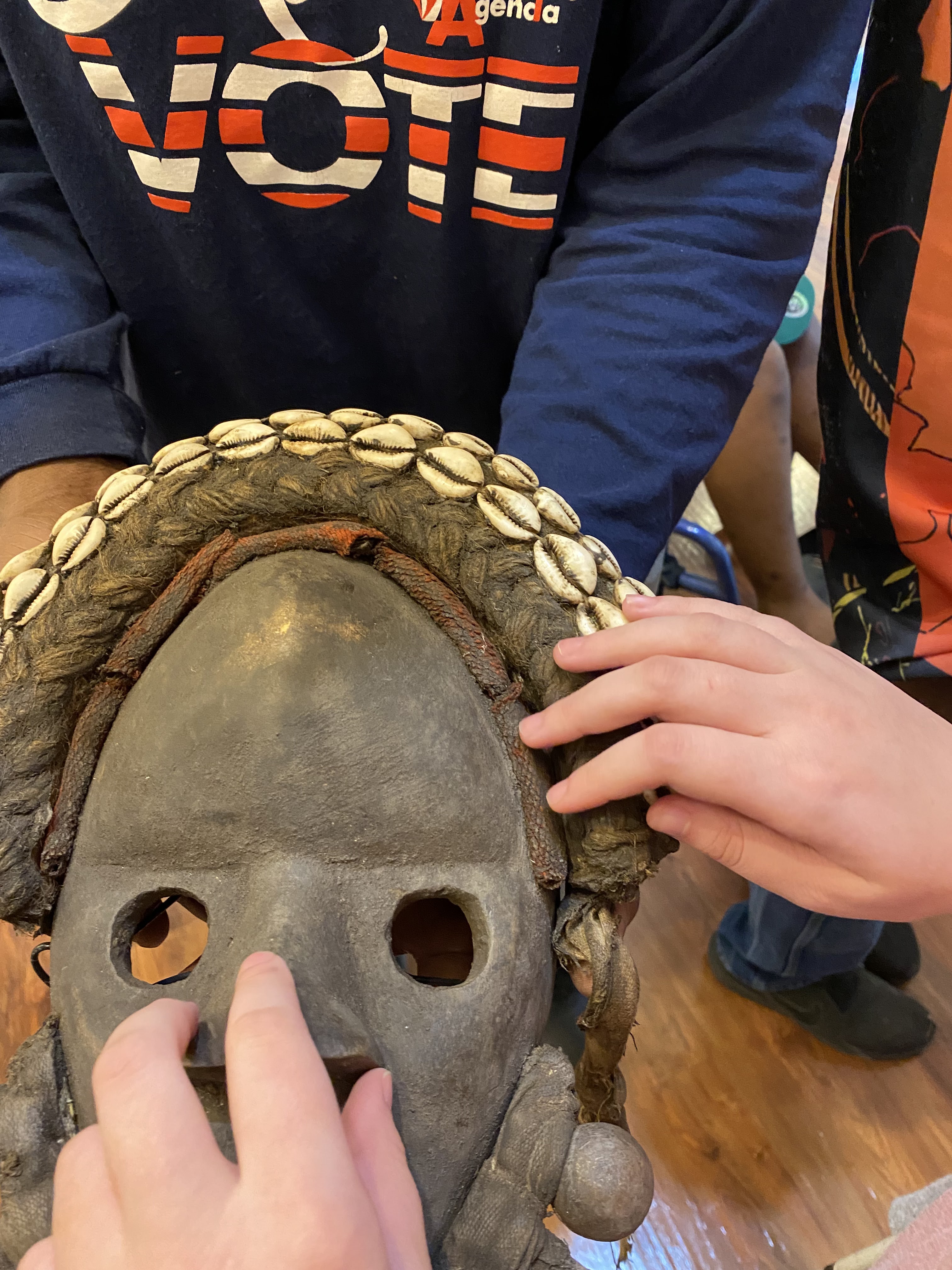
The Harriet Tubman Museum houses a wide range of art, from folk art to contemporary pieces. They allowed our visually impaired students to handle artifacts from Africa as well as inventions made by African Americans. We saw music memorabelia as well, such as Jimi Hendrix's guitar and Little Richard's boots.


The ten minute drive made for a quick field trip, but I think our students were happy to experience a wide range of displays and a personal tour by our very own French teacher.

Friday, September 23, 2022

Relief Sculpture with Found Objects


Playing with blocks is one of the first ways a child learns to play and create. Architects and artists never outgrow the activity.  For our study of Louise Nevelson, I had my students create assemblage sculptures using found objects. Each student went "shopping" at my table full of wooden blocks, stretcher bars, popsicle sticks, and etc. They arranged their items in three different ways, documenting each one with a photograph so that they can discuss the strongest parts of each one and be more intentional with their arrangement before gluing it together.
Then they painted their sculpture a solid color. Some students chose one of Nevelson's preferences of either white or black, but others choose orange, purple, or blue.

A handful of students donated their piece to be part of a large collaborative sculpture. Arranging each individual relief sculpture into a larger structure and filling in the gaps in a way that created a unified piece was a lot of fun. We used wood glue for the small pieces and screwed large boards together. The finished piece was spray painted black, with some turquoise highlights to accentuate the shadows. It's nice to have a 4 foot sculpture that my blind students can experience through touch, that teaches about form, the use of tools (as part of our larger unit on building) and iconic sculptor, Louise Nevelson.


Saturday, September 10, 2022

Caulk Painting

 Hammer and nails, drill and screws, and now caulk. We're exploring lots of media, tools, techniques, and procedures in Art this month.


Caulk is an especially effective thing to use to make drawings and paintings tactile for my visually impaired students.

I've noticed lots of problems in understanding how to make an effective composition, so I had to lay down some guidelines for this one. Each student had to fill the canvas by using large, medium and small shapes, coming in from the edges. Most students created eight to twelve shapes by overlapping some lines. 

Then they filled most of the shapes with a variety of textures by using the caulk to make dots, circles, spirals, dots and spirals. the next day we played around paints.

Some students used liquid watercolor to create a stained look.

Others used latex or acrylic to cover up any marker under drawing lines. Either way, students were happy with their two day tactile project.

Friday, September 9, 2022

String Art

My students love string art. Stitching yarn in a board is therapeutic and the end product is a tactile image, something that they appreciate, since they are visually impaired.


Students place shapes on the back of a piece of matboard, and then went around the shapes using a thumb tack. The wholes were too small for our big plastic needles, so they placed the mat on a wooden bored and punched each hole with a hammer and nail. This was a great chance to practice using the world's favorite building tool.

Even elementary school students, or students with cognitive disabilities, who were totally blind, enjoyed stitching yarn into cardboard. They each picked a stencil of a simple shape, and we poked holes within the stencil. Once the needle was threaded and the end of the yarn taped to the back, they were happy to find the holes and push or pull the needle through each one.  


Screw Art


To go with my theme of "building a great school year," I wanted to teach my students the kind of tools they can use for home improvement projects. Most schools have a core curriculum but students, who are blind, are required to learn an expanded core curriculum that may include Braille, orientation and mobility, cooking, or career exploration...every day living skills that most people learn through observation. I wanted to let my students use a drill to make holes or put screws into wood. Even if they never do it themselves, at least they all know what people are talking about when they reference drills and screws in the future.  For this project, they painted a piece of wood a solid color, painted a black shape on it (most students were thinking in terms of typography), fill the shape with holes, fill the holes with screws, and finally paint the screw heads. It's a simple concept: practice a skill and end up with a tactile piece of art that really pops.