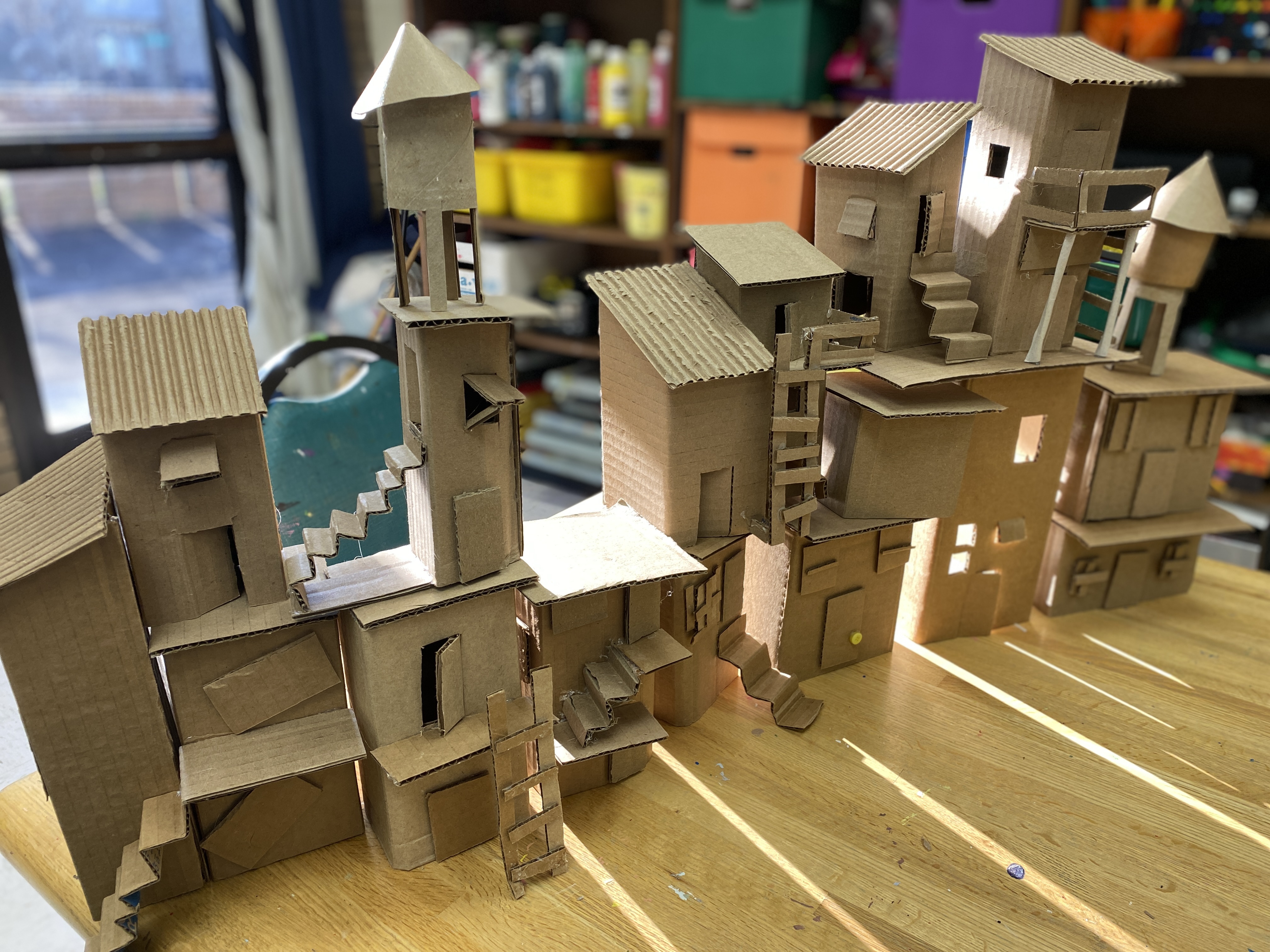
It's nice to balance personal, individual projects to take home, with collaborations. It's a great way to talk about how working together on projects is important, just like is like working to get along with one another is important when living in a densely populated area. A middle school student used a cup and a paper towel roll to make water towers...for the good of the whole.
Showing posts with label collaboration. Show all posts
Friday, January 26, 2024
Cardboard City
Each of my self-contained class students (multiple complex-needs children) began learning about architecture in my art class with a flat cardboard house. Then they made a 3D cardboard house, and a 3D house that would be part of a larger piece. In the U.S., most of our homes are free standing, in fact about 80 million of about 130 million homes are single family houses according to statista.com. But in cities like New York, most everyone will share a wall and floor or ceiling of their home with other people. We stacked boxes and fitted them with ladders and stairs according to each child's preference. Fire escapes are a safety feature you know. Flat roofs are great for growing urban gardens, having dinner, and enjoying the skyline.
Monday, August 22, 2016
Unity and Variety in Art
E pluribus unum. Out of many, we are one. It's true for a great nation and true for a great class.
I started this school year, a couple weeks ago, by trying to create a sense of community in the classroom, so I asked students to talk about the things we have in common. We all live in the same state, spend our days in the same school; we all like music, on and on. Then everyone shares something about themselves that makes them unique. They each have something special to offer the group and it helps when they recognize it and say it out loud. We listened to each other's favorite songs, and looked specifically for repetition in the music and how it unifies the piece. Then we listen again for variety and how the words are changed up or a bridge is added to make it more interesting. This is how it works in visual art as well. Repetition is one way to create a sense of unity in a painting or sculpture. Variety within the repetition makes it interesting. We chose to spend an entire week focused on making circles. One shape, repeated again and again would be pretty boring except that we made them with a variety of sizes, colors, and decorated with different patterns.
We ended up cutting out half of the circles to make a collaborative art piece on the hallway bulletin board. The words, "Our commonality unites us. Our diversity strengthens us," were in the center in print and braille, along with the art standard which requires that each student "Discusses and applies concepts such as...variety within repetition." Empty toulle spools were used to make some of the circles pop out from the board, at varying depths. The students stapled circles, while I hot glued spools and they were pretty pleased with the results. Here is to a year of unity and cooperation among my art students, and to finding the common ground to unify us as a nation and as human beings.
Tuesday, August 16, 2016
Creativity Part 2: Work, Play, Rest
I'm always surprised when I see articles that suggest that every creative person procrastinates or that real artists get up before the sun. In truth, great minds are not all alike. They are vastly different. Every one has to find what works best for them, so it is with humility that offer three suggestions to become more creative, which you can feel free to take with a grain or two of salt. It is these: Work hard, play hard, rest hard.
Pablo Picasso said, "Inspiration does exist but it must find you working." He should know, he was forever working and getting new ideas.
So my first suggestion to anyone who wants to do creative work, is to show up and do the work. Really make an effort! Sometimes the ideas will be great, sometimes they will be poor, sometimes new ideas will be non-existent. But go into the studio, go to your computer, to your piano, to your easel, and do your job. When the economy was collapsing and bankers stopped going to work, I remember hearing world-renowned painter, Chuck Close, comment on NPR, that artists go into the studio no matter what's going on in the economy. Artist's make art because what they do, whether or not anyone buys it.
Ideas inspire work and work inspires more ideas, so work, and think, and search for answers. And when they don't come right away, don't freak out, just let the questions marinate while you work on another project. Solutions aren't always immediate.
PLAY HARD
For the luckiest among us, the line between work and play is very blurry. Actors get to spend their days pretending, artist's get to try new materials and marks. Writers wonder "what will happen if...." This is the exploration of childhood. Piaget called children little scientists because they're trying things out to see what will happen, and Picasso famously said, "All children are artists. The problem is how to remain an artist when one grows up."Creativity requires a bit of fun, in fact Einstein defines creativity as "intelligence having fun." Fooling around is not a waste of time if it gets you seeing things in a different way and bares fruit from time to time.
Take Breaks
Catching ideas can be like catching fish, you have to sit still and relax before they come to you. Often great ideas come in the shower, because, according to Leo Widrich, that's when our minds are relaxed and distracted with a, well, somewhat mindless activity. It's also a time dopamine is released. Many artists keep a pen and notepad on the nightstand since it is just before, during, or just after sleep that they are able to finally let go of the control enough for ideas to come together.Albert Einstein put it so perfectly when he explained it this way: "As one grows older, one sees the impossibility of imposing your will on the chaos with brute force. But if you are patient, there may come that moment when, while eating an apple, the solution presents itself politely and says, "Here I am!"
When I need to give a big presentation, I start with the work, researching, jotting down pertinent ideas. They I let all the ideas simmer, blend, clarify, and organize themselves over the course of weeks, as I drive to work or rest in the hammock. By the the time comes for me to get it down on paper, I already have all the components ready to go and it's just a matter of fine tuning. The fine tuning takes me back to the work mode, and the cycle starts over.
Sunday, August 16, 2015
Collaboration Celebration!
We are back in school and my art room is abuzz with busy artists! Last week, as schedules were getting settled and students were trying to learn class procedures, I had them each create a portfolio (giant paper folder). They had their choice of medium, as long as their name is the focal point. Some used foam stamps, others, marker, hot glue, colored pencils and stencils, and pastel. But with a huge range of ability levels, I found that some students, and some classes work more quickly than others. In order to keep each student engaged in the creative process (and out of trouble), I kept a large piece of butcher paper a table.I used green paint to divide the paper into round shapes, which were then hot glued, so that blind students could feel their boundaries and stay in their section. When anyone had some extra time, they were invited to use pastels or oil pastels and create a pattern within a shape.
My advanced class of low vision students made their own "mural" by dividing black paper with high contrast lines, creating triangles of various sizes.
It was a great introduction to not only shape and repetition, but unity and variety as well. Every class has students who are very unique, but we can be united as a community of learners, just as parts of a "mural" can be visually united. We also discussed the fact that collaboration means having respect for others and their contributions. I have a good feeling about what is possible for my students this school year.
Saturday, September 27, 2014
Line Month in My Classroom: Wire Quilt & String Art
As an artist, I sometimes feel sorry for mathematicians and their limited definition of the line. Lines in art can curve, wiggle, wave, zig, zag, and have three dimensions. Tangible lines are more meaningful to my blind students, who I walk around the room and have feel the spaces between the cinderblocks, the legs of a chair, their canes, wire, yarn, and say, "these are lines."
STRING ART
WIRE QUILT
Sometimes art supply companies create lesson plan ideas to help to their sell supplies and I'm glad I bought into Dick Blick's idea of making a wire quilt. Students used thick aluminum wire, thin, plastic coated wire, pipe cleaners, beads and the list grew each day of the week to include yarn, ribbon, vinyl, tissue paper and buttons. Had I limited each student to one square, I think the easiest solutions would have been their only solutions. By asking them to make as many squares as they could in a week, they were able to explore new materials and ideas, such as making a tic-tac-toe board or an American flag The finished product was 70 squares which ended up being about 40" X 30"
STRING ART
A couple years ago, my sweet Minnesota nephew, John, sent me his string art to show me a project he thought my students would enjoy. I know I loved doing it as a kid, and it turns out that you don't need working eyes to be able to figure out how to make these. The magic is discovering ways to make curves, using only straight lines. I hope this is something my students won't be afraid to try at home.
Subscribe to:
Posts (Atom)