Showing posts with label science and art project. Show all posts

Thursday, May 11, 2023

Earth Based Artwork: Cloudscapes


 We're focusing our last Art Unit on our beloved Planet. Earth Day, Arbor Day, and May Day all of which roll up to keeping our world clean, planting trees and celebrating seasonal changes.

I started by talking about cloudscapes, landscapes and seascapes: all of which traditionally have a horizontal format. For a mixed media cloudscape we taped paper to the back of a board and propped it at a slight angle. One loaded paint brush stroke across the top of the paper has extra water on the bottom edge of the line. That's the part that the next brush stroke needs to be touching in order for it to all blend together and create subtle gradations and transitions. 

We created clouds using pastel on the dry watercolor, mostly creating fluffy top edges and blending them with our fingers for darker shadows on the bottom. Two techniques in two days created heavenly results.

As a bonus science portion of our lesson, we created tactile cloud charts with cotton balls and feathers. Students labeled their clouds in Braille or Large Print. Score a point for cross-curriculum lessons and kids with visual impairments learning through hands-on learning.

Friday, November 11, 2022

Printmaking and Leaves

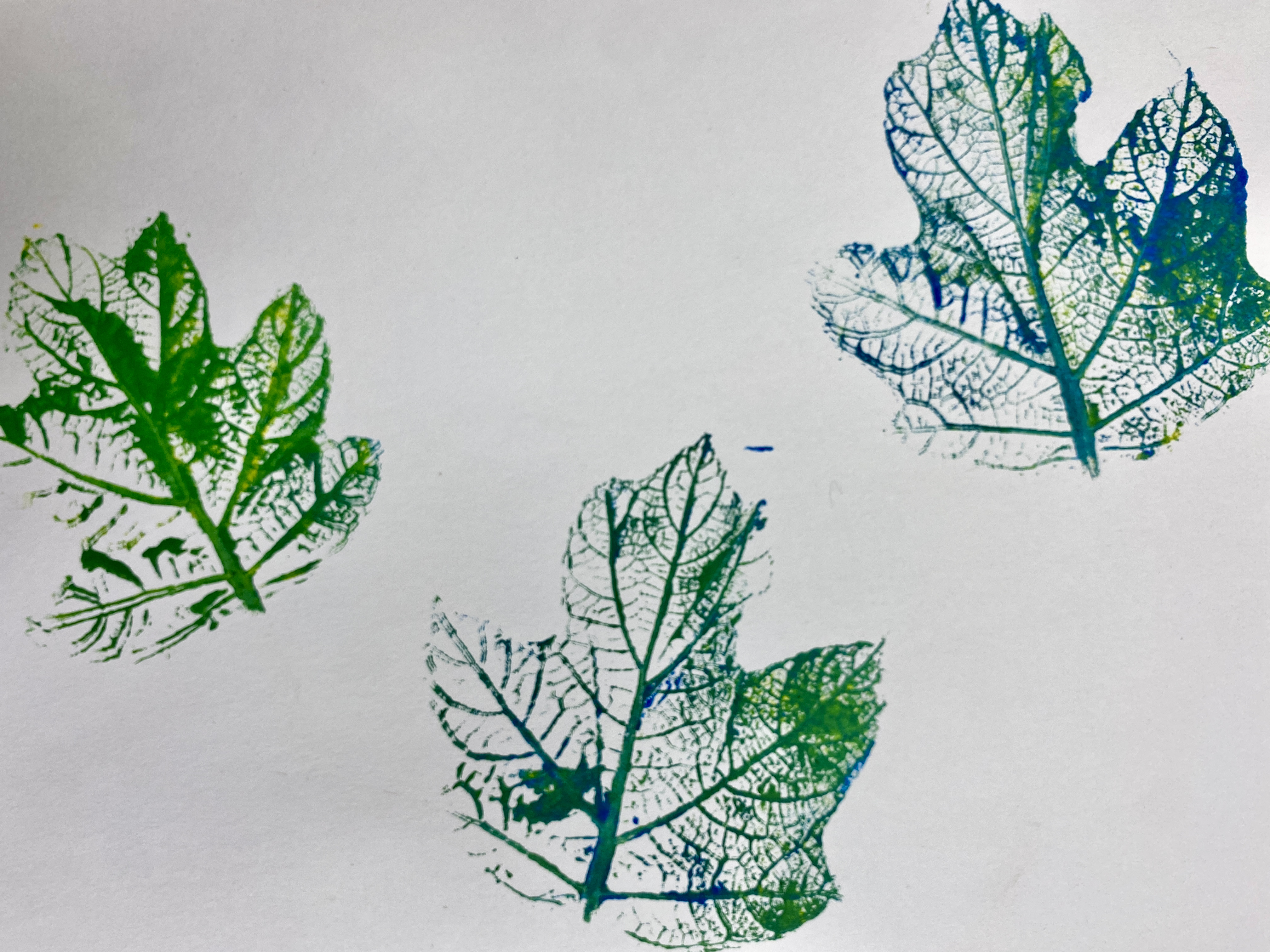
Autumn is the perfect time to do a cross curriculum lesson by marrying printmaking and leaves.  I began the lesson with a 5 minute video about why leaves fall from the trees as the days get shorter in the fall (hint, it has to do with chlorophyll and photosynthesis). Then we took a hike around campus, touching bark, identifying the trees and collecting leaves and pinecones as we went.  

Our first art assignment, used the leaves we collected to make rubbings. The students would arrange their leaf or leaves with the vein sides up, lay a piece of copy paper or newsprint on top and rub the paper with the side of a crayon to reveal the texture and shape of the leaf. Rubbings are a simple form of printmaking and most households have all the supplies on hand. 
The second project was to make leaf prints by painting with tempera or acrylic on the vein side of leaves and then turn the leaf upside down and rolling it with a brayer or rolling pin. You have to be careful not to get uneven pressure through things like finger prints and it helps to place a piece of paper on top of the leaf as well to keep the roller clean. The same leaf can be used multiple times, although if more paint needs to be applied, use it sparingly so as not to fill in all of the gaps between the veins.


Finally we used stencils of various leaf shapes. Students placed a sponge in yellow paint to pat lightly, covering the exposed shapes. A sponge with blue paint dabbed around the edges creates green, and red paint sponged on the wet yellow creates orange. So students are learning leaf identification (biology), mixing of primary colors to create a secondary, (color theory), shape and texture (elements of design), and three different printmaking techniques (techniques and processes), in 3 hours of Art class.
Help the children in your life slow down and enjoy their fall through art making!