Showing posts with label collage lesson plan. Show all posts

Thursday, August 24, 2017

Hip to Be Square: Josef Albers Art Project

Josef Albers was one of the talented German artists who taught at the The Bauhaus School until the Nazis put pressure on the school to shut down in 1933. Hitler hated modern art.  Albers immigrated to The U.S. and went on to teach at the then new Black Mountain Art School. He is most famous for his "Homage to the Square" series, which consisted of hundreds of paintings, each of several squares nestled inside one another.  He was very interested in color relationships. A green may look blue-green next to a yellow, but yellow-green next to a blue.  A warm color will look like it's coming towards you, but a cool color looks like it's receding in space. This week, my elementary students studied Josef Albers.

Color relationships are an interesting thing to try to teach students who are color blind, or completely blind. We've been reading the picture book about Esref Amarmagan, the blind artist from Turkey, who had to keep his colored pencils laid out int he same order, and memorized the color of objects, so he could recreate them in paint in a way that made sense to future viewers.


When I asked one class,"What color is a watermelon?" A couple girls, with some vision, answered, "Green!" But when I followed up by asking about the color of the inside of a watermelon, a boy, with no vision, eagerly said, "Green!" The only way for kids like him to know the colors of things is to be told.
So we talked about the color of things, and then we worked collaboratively to make a giant collage of hundreds of 1 inch squares of color.  First, I used Elmer's glue to trace the giant chart paper grid. After it dried, students felt the squares and were able to independently glue and  place their pre-cut 1" squares or origami paper. 

To avoid gluing the color side down or having to tell each student the color of each square they picked up, I gave them a tool to tell them the color of things, It's the APH Color Test, and you just press it against something and push the button and it will tell you what it is (as shown in the video below). Everyone got a kick out of testing their skin color. Apparently mine is "murky gray beige" or "gray pink" so that information will come in handy next time I buy make up.

Each child also made his/her own, "Homage to 'Homage to the Square'" piece gluing various colored squares together and trying to explain why they thought their combination was working.
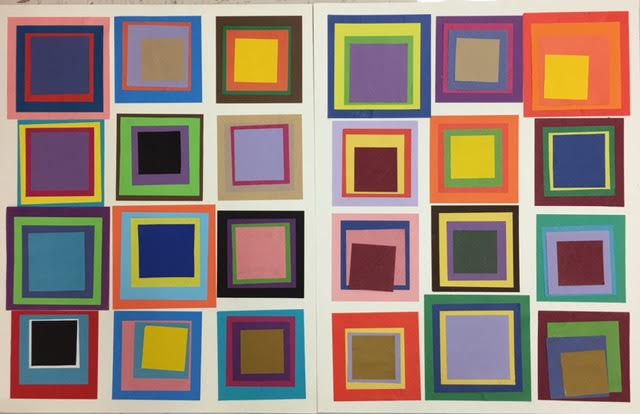


Extra time meant gridding another giant piece of graph paper with glue and having students use dot makers to make color clusters and patterns. What a corful way to start the school year!


Thursday, September 22, 2016

Inspired by Origami

The Museum of Art and Science in Macon, GA currently has a wonderful exhibit of New York artist, Gloria Finklestein's work from the 80's and 90's. The pieces have titles related to Japanese culture, such as "Obon" (the sash one wears around a kimono) and "Hanabi" (which literally translate's into "fire flower" and means "fireworks"). The title of the show was "Origami Interpretations," so to prepare my students for our field trip, I had them make several origami objects. We started very simply with a cat and/or dog and tried to use tactile methods of making it more believable and meaningful for my blind students. They then chose whatever they wanted to make: boats, cootie catchers, balloons, boxes. We also watched Robert Lang's Ted Talk "Flapping Birds and Folding Telescopes" about new origami methods. https://www.youtube.com/watch?v=UNdD5Kxdkpg

The museum was so accommodating, in terms of our visual impairments, offering tactile swatches for students to feel, and a template of the obon shape since the actual canvas could not be touched. Several of Finklestein's pieces were meant to be touched, however, with circles that spin and panels that flip. While we were there we attended a planetarium show, animal show, explored the Discovery House, took a nature walk, and had a picnic before coming back for the last three periods of the day.

The follow up assignment was to create a sculpture or collage in the style of Gloria Finklestein. In other words, to make something inspired by the artwork that was inspired by origami. Students used cardboard triangles, glue sticks, and origami paper, or colored copy paper with their own pattern. Some of the collages had cardboard shapes under the paper to help it become easier "see" with their hands.


When a relationship is formed between a teacher and a museum, it can take education to the next level, and make a learning unit more memorable for the students who experience it.