Friday, January 26, 2024

Cardboard City

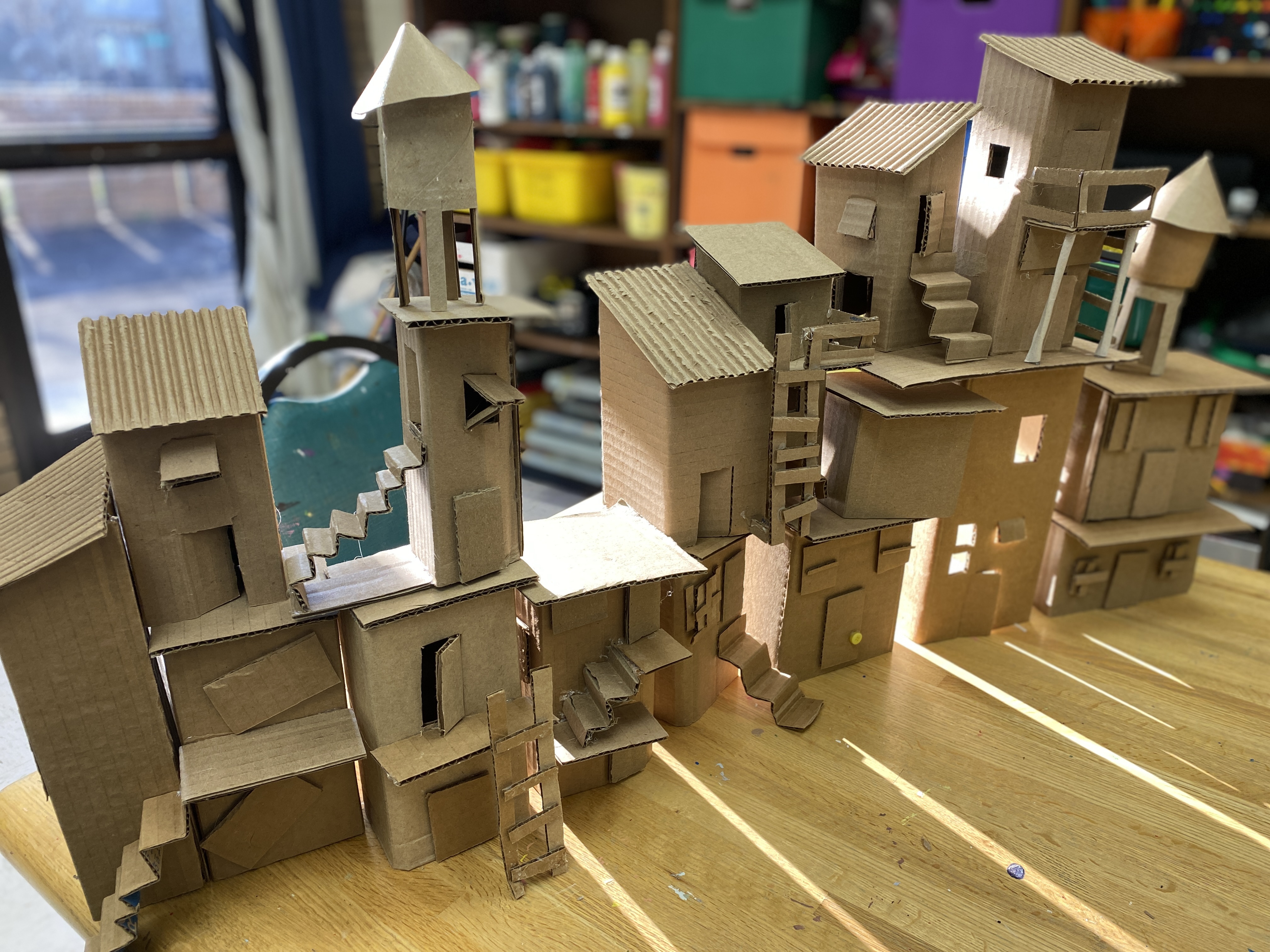
Each of my self-contained class students (multiple complex-needs children) began learning about architecture in my art class with a flat cardboard house. Then they made a 3D cardboard house, and a 3D house that would be part of a larger piece. In the U.S., most of our homes are free standing, in fact about 80 million of about 130 million homes are single family houses according to statista.com. But in cities like New York, most everyone will share a wall and floor or ceiling of their home with other people. We stacked boxes and fitted them with ladders and stairs according to each child's preference. Fire escapes are a safety feature you know. Flat roofs are great for growing urban gardens, having dinner, and enjoying the skyline.

It's nice to balance personal, individual projects to take home, with collaborations. It's a great way to talk about how working together on projects is important, just like is like working to get along with one another is important when living in a densely populated area. A middle school student used a cup and a paper towel roll to make water towers...for the good of the whole.

Friday, January 19, 2024

Simple 3D Cardboard Houses for Kids


Understanding the difference between two and three dimensions is made easier when you go from making a flat thing to a 3D model. For my young art students' second architecture project, we went from one wall to four walls before adding a roof. Again, the building process begins when I ask each student if they wanted a tall or short house, and then ask what kind of roof they wanted. The houses looked very similar to their flat counter-parts, but they lined up to make a little neighborhood, and this made it easy to talk about materials. I brought in linoleum and ceramic tile. They could here the different sound each surface material made when it was tapped on the table. Feeling wood and the bricks on the outside of the building made for another interesting comparison, since both bricks and tiles are made from clay. 


We get into the concept of form following function as I explain to them about the benefit of having sloped roofs in keeping rain and snow from sitting on top of the house, and the fact that eaves can keep water away from the siding and foundation. I tell them that 400 years ago, when people stood under the eaves to get out of the rain, they could hear what was being said from open windows, which was how the word "eaves-dropping" originated.

Little kids love to play along as I retell the "3 Little Pigs." I only half-way tell, it since they know the lines, "Little Pig, little pig let me in!" and "Not by the hair of my chinny chin chin!" well enough to finish them. And even a non-verbal student blew on the house every time the wolf said he'd huff and puff. We removed one of the 3 houses for each phase and made sure that the last house had a chimney. It only takes a few minutes to incorporate language arts, or vocabulary (such as surface treatments and building supplies) in a way that will help them understand the world around them. Art classes are about so much more than learning how to make art.


Kid Craft: Tactile Cardboard Houses

 Architecture starts simple when you're dealing with kids who are working at pre-school level of cognitive abilities. And because my students are blind, and may have never seen a house in it's entirity, I started my architecture unit with the parts of a house. Walls, roof, doors, and windows. I'd ask each student if they wanted a tall or short house, a triange or rectangle roof, a single or a double door. How many windows? How many panes in each window? Would you like shutters or a window box? What about a chimney for Santa? They make choices and glue each piece that I cut out cardboard according to their commands. What we end up with is a tactile version of an elevation of a house. Most kids know how to draw a recognizable house by kindergarten, but without vision, this is the next best thing. These houses are  building blocks for our unit to continue, but they'd also make a fun craft for any preschooler.


Friday, January 5, 2024

Vision by Touch: Art Exhibit by Blind High School Students

It has been 11 years since I've had my last solo art exhibition, which also happened to be my first semester teaching at the Academy for the Blind. All of my creative energy has been dedicated to my students, but it's been interesting to realize that I'm every bit as excited about the current exhibit I curated for my students as I was, in the past, for my solo shows. Helping others realize their potential is essential to me realizing my potential. I love to see those kids shine!


I teach Kindergarten through 12th grade, and over half of my students have disabilities beyond blindness. This requires small class sizes, which means we produce much less work then schools with hundreds of art students. The limitations of my ten high school art students haven't kept us from having two exhibits and an art sale within three months, and this show is one I'm especially proud of.


The show consisted of the Braille book sculptures, wooden sculptures, small clay heads, quilled magazine pieces, a couple of caulk paintings on canvas ,and oil pastel drawings. Six assignments in six weeks, for all to see. 


My husband spent a Saturday morning helping me hang the show.  How I adore him!


The pedestal pieces in the middle of the room stole the show, but white shelves also provided a nice space to cluster work. I love the white on white aesthetic, it feels like the look of serious art.

I managed to snap a few pictures of my students taking in the show before the opening reception began.


Friends, family, colleagues, professors, and college students all turned out for the reception! I gave a slide lecture; we had live music performed by a middle school teacher (Chance Mormon), and we snacked on refreshments. They got a taste of success a long with their treats, which will motivate them in the future to take assignments seriously and make art worth sharing. When they succeed, I succeed.

The show runs through January.


Friday, December 22, 2023

Sugar Cookie Creativity


Edible crafts are the perfect way to get students engaged in the classroom and family together during the holidays. Decorating sugar cookies can feel like a coloring book, obvious answers answers are the first you see, but once you forget what the "cookie cutter" solutions are, the options become infinite. An upside down Santa or a bell shape can be used as monster heads. A stocking Santa head shape can be made into a fish, and even traditional solutions can be given twists like a gingerbread man with an exposed ribcage and fins for arms. Traditional approaches for conservative cookie decorators are always a back up, but why not encourage some originality and see what happens?


Wednesday, December 20, 2023

Student Christmas Craft Sale

The last week before Winter Break, my students printed rubber stamp gift cards, painted wooden sleds and sleighs and trees, collaged tactile Christmas cards and melted wax and molded candles. The projects were small enough that they could be done within a class period or two and everyone could pick the type of craft that interested them the most. We set up one table of those craft items ranging from 25 cents to 6 dollars, and ended up making $200 hours within an hour. We're going to use it for something fun like pizza.


Painting Party Backdrops

Painting 8 foot high presents for party backdrops this year, made for a quick and easy math lesson for a couple of special needs students. For example:  they had to  divide the panel in half (vertical line at 2 feet in from the side) then divide the 9 inch ribbon in half and make 4.5" marks on either side to place the painters tape. A similar problem was made for the horizontal ribbon. We mixed green paint from yellow and green, so suddenly it was a color theory lesson) and then the painting began. Within a few hours we had simple images that made for a big impact for pictures of Santa at our student party.

We had another couple of large panels and a smaller tree at a seating area for students to take selfies and group shots throughout the party. By the time you add music and food to the decorations, you've got yourself a party! High School students are more likely to participate in karoake and dancing then middle school students, so we set up games like  twister, giant Jenga and Connect Four for smaller group activities. The photo booths were a hit regardless of age. Everyone had a blast!


Another fun backdrop for Santa photos included three yard reindeer with twinkling lights, a plywood sleigh made by a friend from church, and cardboard trees that we painted for a dance years ago. This set up was a hit at two separate parties! It's worth putting in a lot of effort into one year of building so that future years are just a matter of repainting and tweaking!