Showing posts with label color lesson. Show all posts

Friday, January 31, 2025

Analogous Watercolor Assignment


For a quick and easy color theory project, I had my students choose three neighboring colors on the color wheel to make an analogous watercolor painting. Students began by using masking/painter's tape to break up the picture plane into small, medium, and large, shapes. I like it when the strips of paint go off the edges of the paper, but smaller pieces can work too, as long as there is overlap of tape.

blind student uses fingers to navigate what parts of the paper still need painted.


blind student adding value to tape edges
Then the students wet their entire piece of paper with by brushing or spraying water on their watercolor paper. Next, they painted one color at one end, and then overlap a second color blending along the way. It could be two secondary, such as a blue at one end and red at another to make a purple in the middle, or they could use a primary in the middle like a blue with a blue-purple on one side and a green-blue on the other. 

That could be the end of the assignment, but I found everyone was able to take their painting to a next level but tracing their tape with a pencil and smudging it with their finger or gradually adding lighter value to fade it out, to create a shadow once the tape was pealed off.

By continuing to peal off one piece of tape at a time and shading around the intersections, a sense of layers and depth is created. For those with vision, they could even activate the background by creating even more layers. This was done by laying the tape done again in different positions and retracing/blending, and pealing off. What could have been a five minute exercise in mixing two or three colors to create a color harmony, now becomes an interesting composition using not only color, but line, shape, and value! That's a lot of ground being covered for a two day project.


Friday, January 20, 2023

Georges Seurat and Color Theory Lesson


I've been humming "Que Sera, Sera! Whatever will be will be!" All week as my students have been working on their Seurat style paintings. I've been coming at it from as many angles as I could, making references to the musical "Sunday in the Park with George" and the scene in Ferris Bueller when Cameron is sitting in front of Seurat's most famous painting "Sunday Afternoon on the Island of La Grande Jatte" and going from big picture view to focusing on the individual dots. My students have heard the "I didn't have the Monet to buy the Degas to make the Van Gogh." joke more than once leading up to this project as we've watched videos and had discussions about Impressionists and Neo Impressionists. But one of the most important parts of preparation for this assignment was making a color wheel.
Differentiation is the name of the game when it comes to color theory and students who are visually impaired. Impressionism is about capturing light and color at any given moment so subtle shifts between an orange and a yellow orange are important to capture. My students used red, yellow, and blue to mix and paint all of their secondary and tertiary colors before arranging and gluing them to a neutral background.
For students who are colored blind or completely blind we used Mr. Sketch markers with the scent to match each color. Blue smells like blueberry; red smells like cherry. And instead of mixing paint they would take a pointillist approach and stipple dots of two primaries to make each secondary. The part of the color wheel for green, for example, would have yellow and blue dots together that would read green from a distance. For students who are totally blind added a tactile element as well. Maybe red would be rice and blue would be beans, which means, the green section would have dried rice and beans glued to it.  These adapted color wheel assignments only had primary and secondary colors.

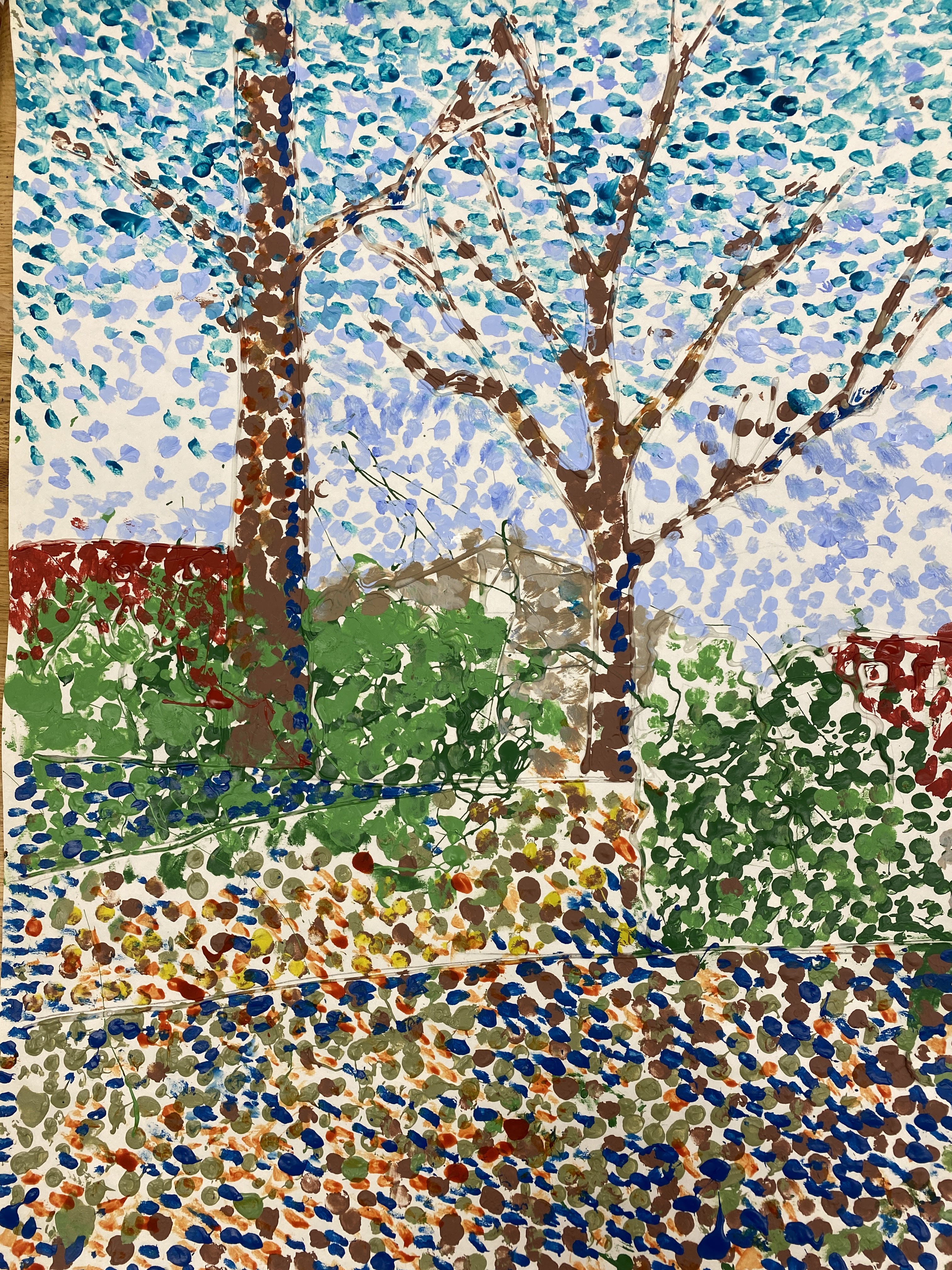
The fun begun when started using their understanding of color to mimic Seurat and use paint brushes or the backs of their pencil or to put small dots of color close together to create the illusion of another color. Middle School students did portraits.
High School students did landscape paintings. We didn't paint en plein air (outside) as the impressionists did, but neither did Seurat for his huge canvases. Instead we walked around campus and took pictures of interesting views. Then we came back to the classroom and printed out the most interesting image by each student.
Students transferred their photo to a large sheet of paper, some of the pencil drawings had to be hot glued in order for students to feel the boundaries of shapes, and then they began to work their magic. The confetti of color and cracks of white paper create a sun dappled effect. In our critique, the images with the greatest value contrast faired the best. I hope students will remember this part of art history fondly and appreciate the special quiet spots on campus more fully, as a result of this project.